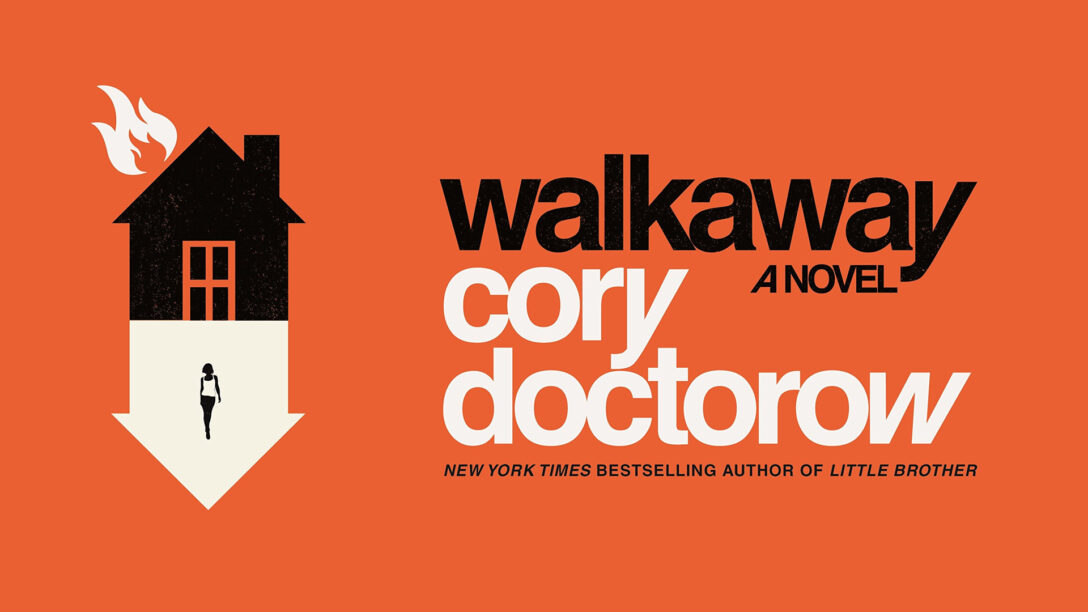
There is a history of walking away in utopia, think The Ones Who Walk Away from Omelas (Le Guin) or Thoreau leaving civilisation behind for Walden Pond. So what does Cory Doctorow bring to the table?
Well, it includes 3D printed guesthouses with inbuilt Japanese-style onsens, enzymes that turn water into beer and oh yeah uploading your brain so you never ever die. But if life’s that good for the walkaways that’s obviously going to threaten the ‘zottas’* who lord over ‘default’**.
*the more-than-mega rich
**the default ultra-capitalist world from which one might decide to walk away
The novel follows the walkaways through a generation as they struggle to bring about their revolution. They negotiate utopia-building and the possibilities of a new post-human existence amongst themselves and in conflict with the zottas, who want to hang onto control and grab that immortalising new tech for themselves.
Walkaway is now the best contemporary example I know of, its utopia glimpsed after fascinatingly-extrapolated revolutionary struggle.”
William Gibson
Example of what? Who knows. If Gibson means to imply this is the best contemporary utopia out there, there’s much to debate on that point.
Cory Doctorow vs Jenny Odell
I read this in tandem with previous book of the month How to Do Nothing by Jenny Odell. One of the movements Odell traces in her book is ‘a dropping out, not dissimilar from the “dropping out” of the 1960s’ (xi). This led me to think the two might be thematically similar. In fact, they stand in stark contrast to each other.
I’m suggesting that we fiercely protect our human animality against all technologies that actively ignore and disdain the body, the bodies of other beings, and the body of the landscape that we inhabit.”
Odell, How to Do Nothing, p.28
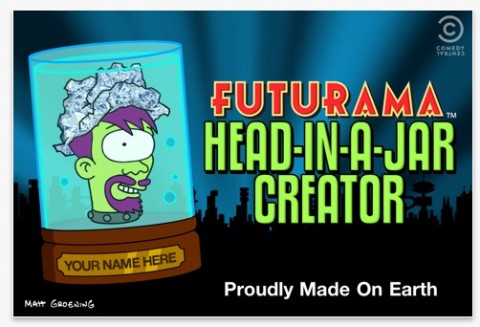
Doctorow’s tech-dependent vision of a never-ending good life is in direct opposition to what Odell suggests. It gives off Futurama vibes.
“In the future, we’ll all be heads in jars,” said Groening. “But right now we can live this utopian fantasy in cartoon form.”
In Doctorow’s utopia it’s not even heads in jars, it’s minds in boxes. His seeming disdain for human animality is also reflected in a hostile landscape. Walkaways must continually be protected by buildings, vehicles or suits. Food is 3D printed not farmed. Despite the amount of sex in the book, he seems to consider embodied existence inessential.
Oh no Doctorow, it’s not eco
Where Odell asserts ‘it may only be among the most elaborate web of the nonhuman that we can most fully experience our own humanity’ (148), for Doctorow the more-than-human world hardly seems to exist. Which is unsurprising, considering the body and its biome are also apparently optional for humanity in his utopia.
This is certainly not an eco-utopia, and it is not in tune with current ecological thinking. Odell argues ‘What’s especially tragic about a mind that imagines itself as something separate, defensible, and capable of “efficiency” is […] it’s based on a complete fallacy about the constitution of the self as something separate from others and from the world’ (139). Borrowing the words of writer Alan Watts she lambasts our culture for ‘a completely false conception of ourselves as an ego inside a bag of skin’ (140). Does it burn, Doctorow?
This utopia isn’t a departure. It doesn’t depict a fundamental change in the way we perceive ourselves in relation to the rest of the world. Despite a shift to communal ownership of assets, it remains human-centred and materialistic. It is a tech-saviour story, which distances humans from the matter of the world. For all its differences, it’s same-old, same-old.
Now you, of course, may disagree. You can air your views in the comments below. Or, if you are local to Bristol, UK, come along to our next Utopian Book Collective meeting to discuss in person.
Anthropy≠Anthropocene, Shiiku Collective, 9 March 2023, Strange Brew, Bristol.
Carolyn Dougherty reflects on this event, which promised:
expressive spoken word on fighting the barriers of capitalism, interactive visuals co-created by our robot friends, ambient electronic beats with soft rainforest settings, and the voices of those ready to design a world that can be peacefully navigated by all.”
I’m a woman in my 50s, reasonably well read on utopia but perhaps not entirely up to date. I was hoping for fresh, young perspectives on living joyfully in a world we have (at best) badly and unconscionably damaged.
Instead, I heard several young people perform poems and songs expressing their desires in a world where they feel marginalised. The poems weren’t bad; in fact, I thought a couple were quite good. I’m glad I heard them. But, they primarily dealt with the individual’s inner world.
I hope everyone reading this has had the experience of engaging with a piece of art then stepping out into the world astonished at how your own perceptions have been changed by it. That kind of mental and emotional rewiring doesn’t happen when the art is focused on better understanding the artist.
Self-expression as a tool of late-stage capitalism
It is a genuinely powerful act to declare to others that we are proud to accept something about ourselves that our culture has taught us we should be ashamed of. But I dispute that it ‘fights the barriers of capitalism’ and offers a new vision of our world. Rather, it redraws those barriers further out, to enclose more of us.
Self-expression is something we’re taught to value, even revere, and it is valuable. But it also happens to be the ideal lever for late-stage capitalism to break into our interior world, to appropriate what resources still remain out of its control.
In the late twentieth century, the consumption machine encouraged us to express ourselves by buying things. Things that signified allegiance with whatever group we might want others to believe we were affiliated with. By acquiring, wearing or using things coded to belong to a certain group, we hoped to send signals that encouraged other people to assign us the status and group affiliation we desired to project.
What we now optimistically refer to as late-stage capitalism is much more sophisticated, and much less overt. The machine no longer creates and disseminates the rules for obtaining affiliative or distinctive things. Instead, we are more likely to self-define. We choose the signals ourselves, then inform others what these signals mean to us and should mean to them.
A collection, not a collective
It’s still the same mechanism, keeping us focused on who we are and how we identify. We remain preoccupied with both sending the correct signals and ensuring that others receive them in the correct manner. The capitalists win again, as this preoccupation, even obsession, with what we are signalling precludes any possibility that we might actually pay genuine attention to others.
This situation resulted in a grouping of artists that could more rightly be called a collection than a collective. Individual atomised people pinging packets of information to each other as a substitute for actually communicating, engaging, forming bonds, and creating the conditions for effective collective action.
Towards a post-capitalist utopian poetics
Art that focuses on one’s perception of the world paradoxically brings people closer together than art that focuses on one’s perception of oneself. Perceiving the world is something we all do, and an experience we can genuinely share. (I’m afraid not everyone is thinking about you.)
This kind of art is almost the opposite of the scientific method. Science attempts to organise and achieve an objective description of the world. Its goal is for us to have the same, repeatable, predictable experience. And economics, of course, likes to position itself as a science.
The goal of art is to help us have as many different experiences of the world as there are people. Relating to each other through sharing our experience of the world may be the most effective way to create the kinds of shared experience that could lead to collective action, and someday the creation of what could be a utopia.
Carolyn Dougherty is an economic historian and railway engineer currently based in Bristol. Her research and writing addresses the origins of capitalism and the development of the corporation in early nineteenth-century England. She is a member of the Utopian Book Collective.
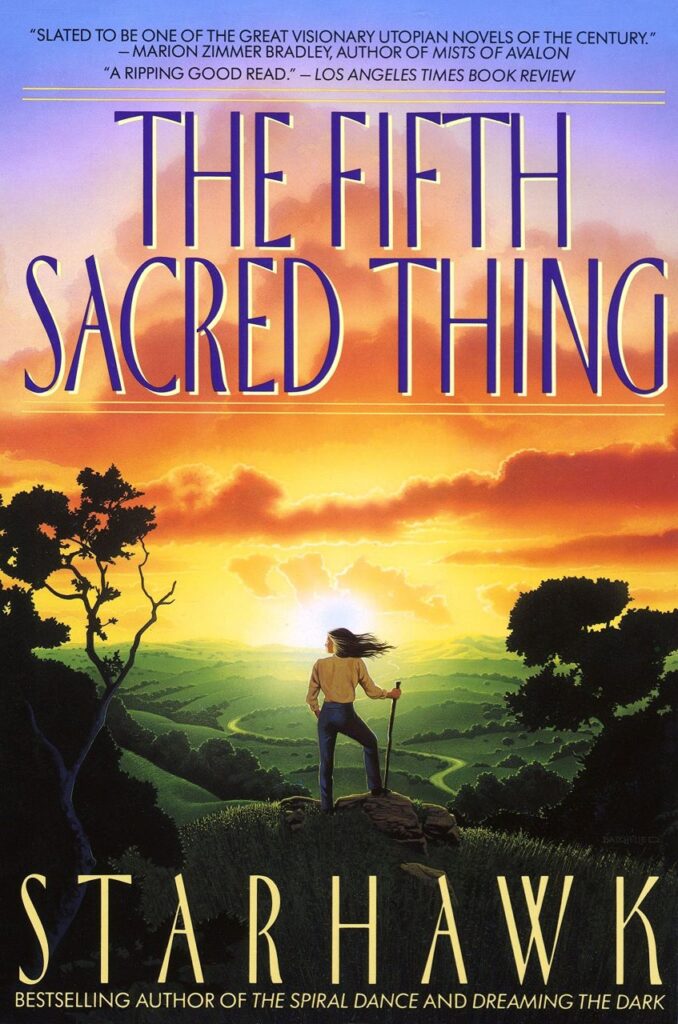
The Four Sacred Things are earth, air, fire, and water. Nobody can own them or profit from them, and it’s our responsibility to heal them and take care of them. That’s the basis of our politics and our economy.”
Such is the basis of this New Age-y eco-utopia set in the near future in San Francisco. The fifth sacred thing of the title is”spirit”, and it can only flourish when the first four sacred things are taken care of.
However, there’s more to this novel than flower power and free love (although it doesn’t scrimp on either of these). The utopia is an enclave in a hostile world, “a green island in a toxic sea”. The planet is polluted. North America is ruled by religious fundamentalists and cut off from the rest of the world. Outside of our utopia, drinking water is scarce and expensive. Stewards control the water, and by doing so control and coerce the population at large.
This utopia was hard-won and inevitably will not remain unchallenged. Traditionally, a utopia is a static, perfect ideal that is explored over the course of the book. This example is a precarious paradise. The subject matter of The Fifth Sacred Thing is more about the response to external threat.
The inhabitants of the utopia are pacifists, whereas the Stewards with their armies very much are not. The book explores what happens when a non-violent society is confronted by a violent one. Can principles of non-violence be sustained when you are under attack?
The question of what pacifist and/or non-violent utopians should do in times of physical threat seems timely. Whether it’s Russia’s invasion of Ukraine or the policing of protests, putting pacifist principles into practise in the face of violence is not at all straightforward.
Jack Halberstam’s keynote ‘Unworlding: An Aesthetics of Collapse’ really was the absolute highlight of the Utopian Studies Society of Europe conference. But wait! You didn’t have to be there! A version of the lecture is available on YouTube so I wanted to share the details. It contains some real IDEAS about UTOPIA and I highly recommend checking it out.
If you want to get to utopia, you can’t start from here
Halberstam opened with a huge challenge to the genre of utopia. We are limited in what we can imagine, he argued, bounded by what we know. Going forwards only carries over the problems of the present into the future. The necessary project, he suggested, is not worlding but unworlding.
The use value of utopia is often thought to be in prefiguring changes we would like to see in the real world. For Halberstam, this function is moot. There is no hope in bridging from here to the future. You must instead go back to dismantle the present.
Nothing matters
Halberstam used the art of Gordon Matta-Clark, shown above, to illustrate the creative potential of deconstruction. In carving a spiral through a building due to be demolished in Paris, Matta-Clark employed his architectural knowledge to create an absence of building. In this artwork, the artist’s material is nothing. It is art because of what has been taken away.
This work subverts the logic of capitalism, which demands things are made, possessed, consumed. As such, it also deconstructs the system we are caught in. Halberstam’s suggestion was this is a surer first step towards a new world than imagining a utopia.
Advocating for entropy
Moving ever further away from glossy utopian futures, Halberstam then set out his argument for embracing entropy. We will have to follow the logic of other lifeforms, he argued. Lifeforms that know what to do around ruination. Mushrooms, microbes, beetles all require decaying material as sustenance, and through processing what is rotten create the conditions for new life.
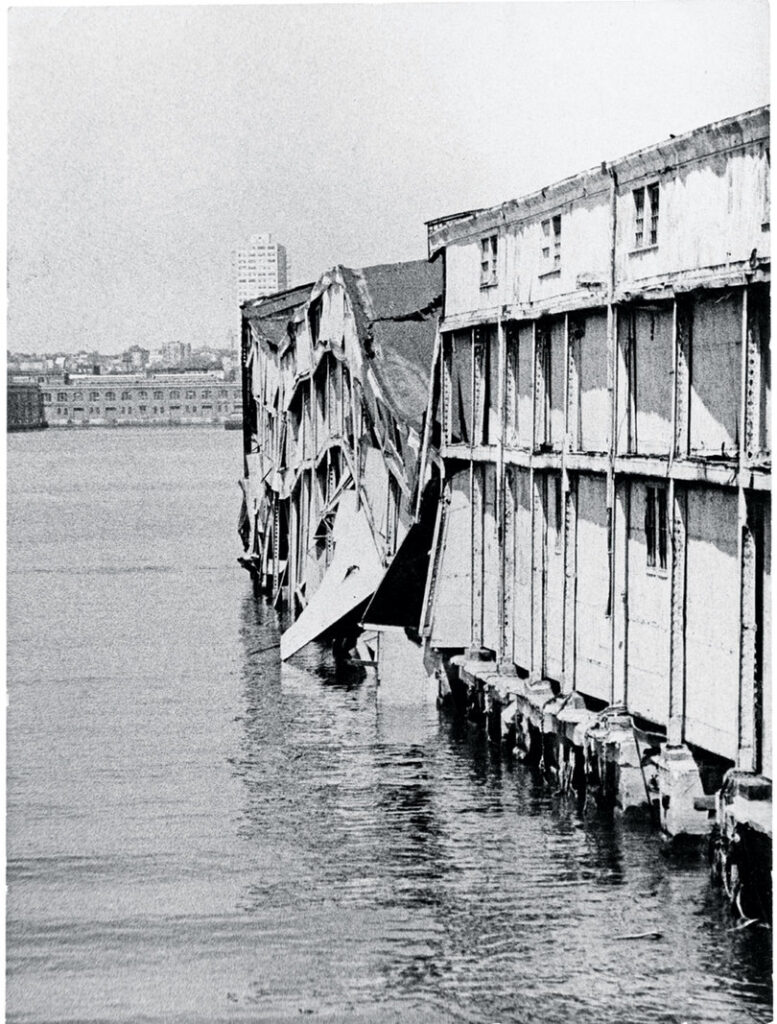
In discussing ruins and the marginalised lives that exist amongst, and may emerge from, them, he referenced the photography of Alvin Baltrop. Baltrop’s pictures captured the New York’s collapsing West Side Piers in the 1970s and 80s, and the gay men who cruised there.
Drawing his final example from literature rather than art, Halberstam went on to discuss N. K. Jemisin’s Broken Earth trilogy. His analysis centred the faction within the novel who want to see the end of the world, not save it. These characters are some of those who have been marginalised and exploited by the prevailing society. Halberstam drew parallels with Afro-pessimism, asserting the only way out of white supremacy is to destroy the world it has built. By implication, a utopianism that aims to repair the existing system would be a neo-colonial project.
After attending the lecture, I re-read the last two novels of the Broken Earth trilogy. I was left wondering whether the ending of the trilogy sustains the Afro-pessimist reading.
— SPOILER ALERT — Skip this section if you haven’t read The Stone Sky in its entirety!
Nassun, who had wanted to all-out destroy the world, in the end executes her mother’s plan to fix it. In the aftermath it is acknowledged that, despite the fix, the current Season will continue for some time. While it is hoped node maintainers will no longer be required, just exactly how things will work out remains uncertain.
The result is certainly an undoing, yet it isn’t total destruction. Is this a large repair job or are things are sufficiently unwound to start again?
Watch online
You can find a version of Jack Halberstam’s lecture Unworlding: An Aesthetics of Collapse online, see below.
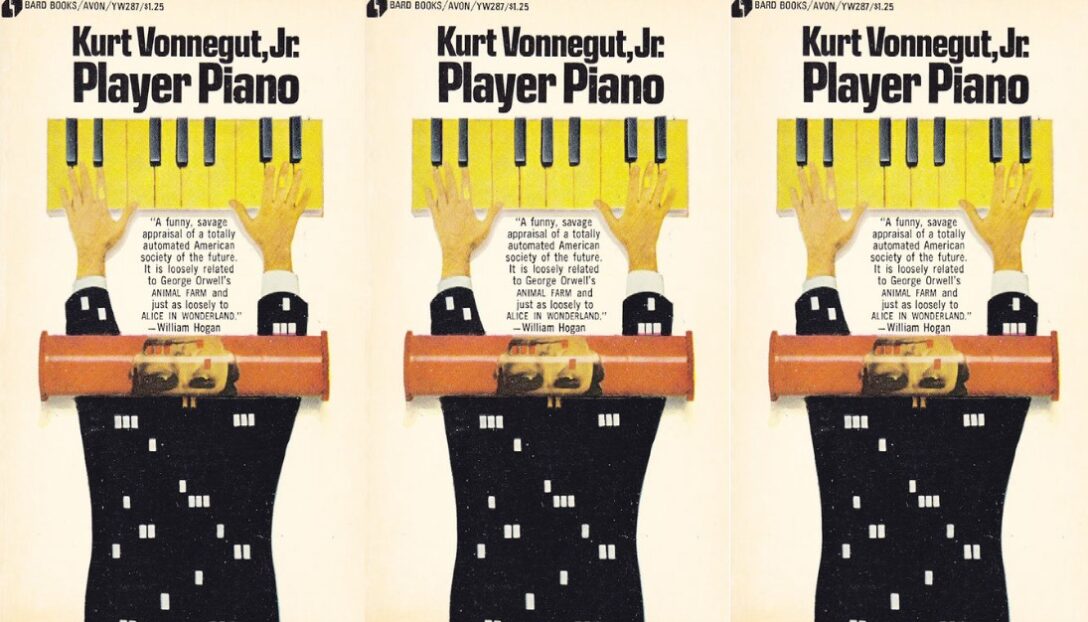
Player Piano, Kurt Vonnegut’s first novel, was published in 1952. It’s a dystopia with a wry sense of humour, which is atypical for the genre. But dystopia and farce both extrapolate events to disastrous and absurd degrees. Vonnegut makes highly effective use of this point of crossover.
Player Piano is set in an alternate 1950s. Technological advances in machinery have led the US to victory in an horrific World War III. The logic of machine-does-best is now being applied to peacetime society.
An elite few go to college and become engineers and managers. They oversee the machines that do the labour men used to do. (Noting it’s men who work outside the home in this society – it’s the 1950s, remember). With no work, the men are offered 25 years either in the army or a maintenance crew called the Reconstruction and Reclamation Corps, or ‘Reeks and Wrecks’.
From the position of the engineer and manager classes, the former working man has everything he needs. He has food, ‘a place to live and warm clothes. He has what he’d have if he were running a stupid machine, swearing at it, making mistakes, striking every year, fighting with the foreman, coming in with hangovers’ (37). And yet, things don’t come off as seeming entirely ideal…
A dystopia for our times?
Despite being over 70 years old, a dystopia where the robots take our jobs reads as timely. It’s relevant when ChatGPT is threatening the livelihood of copywriters, self-checkouts are replacing supermarket cashiers and you’re more likely to buy your train ticket from a machine than a ticket office. You can see why Vintage saw fit to republish it last year.
Man has survived Armageddon in order to enter the Eden of eternal peace, only to discover that everything he had looked forward to enjoying there, pride, dignity, self-resect, work worth doing, has been condemned as unfit for human consumption.
Player Piano, p.300
To modern readers, the automation in Player Piano is delightfully analogue. A master machinist’s movements are recorded onto tape in the same way a piano roll is recorded. The resulting tape loop is run through a machine, which can repeat the machinist’s actions as often as required. However, the principle transfers easily to our digital age. Vonnegut’s description of his protagonist Paul arriving at a train station late at night to find no cabs available to take him home reads as somewhat prescient:
He looked helplessly at the automatic ticket vendor, the automatic nylon vender, the automatic coffee vendor, the automatic gum vendor, the automatic book vendor, the automatic newspaper vendor, the automatic toothbrush vendor, the automatic Coke vendor, the automatic shoeshine machine, the automatic photo studio, and walked out into the deserted streets.
Player Piano, p.257
Then and now
As can be expected for a 70 year old novel, aspects of the book are dated. Labour is divided strictly by gender. Women are would-be homemakers and men are would-be machinists. The domestic work too is done in seconds by machines, leaving everyone ill at ease. In the middle classes, women are still homemakers but also do the prep for their engineer manager husbands. Anita, Paul’s wife, chooses and sets out his clothes for every occasion. She even writes a script ahead of an important meeting with his boss to ensure he’s briefed with all the best possible answers. Unfortunately for Anita, her goal of advancement within society doesn’t find a match in misfit Paul. He would rather get his hands dirty on a farm, until he discovers farms smell of manure, which spoils the idyll.
Then there is the possibly Orientalist depiction of the ‘Shah of Bratpuhr, spiritual leader of 6,000,000 members of the Kohouri sect’ (18). The Shah and his nephew-interpreter are given a tour of America. They serve as naïve outside observers, much like the child in The Emperor’s New Clothes. The Shah calls out American citizens as slaves and their machines as false idols, to the eye-rolling of his tour guide who assumes he is too backwards to grasp the greatness of what he is seeing.
Anti-colonialist themes
Yet, Vonnegut clearly maps out how the prevailing American logic follows on from the colonisation of the continent and suppression of its indigenous people. He starts with something akin to a land acknowledgement:
Here in the basin of the river bend, the Mohawks had overpowered the Algonquins, the Dutch the Mohawks, the British the Dutch, the Americans the British. Now, over bones and rotten palings and cannon balls and arrowheads, there lay a triangle of steel and masonry buildings, a half-mile on each side – the Ilium Works.
Player Piano, p.3
The revolutionaries against the system align themselves with the indigenous people who suffered at the same hands before them. The preacher Lasher says ‘It had become a white man’s world, and Indian ways were irrelevant. It was impossible to hold the old Indian values in the changed world. The only thing they could do in the changed world was to become second-rate white men or wards of the white men’ (288). The revolutionaries name themselves after an indigenous religious movement that made an analogous ‘one last fight for the old values’ (also 288).
While this might be construed as cultural appropriation, it highlights that the logic of progress in contemporary US is a continuation of the colonial project. This progress-driven logic is under critique in Player Piano. Paul, finding his calling as the revolutionaries’ figurehead, declares ‘a step backward, after making a wrong turn, is a step in the right direction’ (312). This appears ahead of its time when the fields of literary criticism and utopian studies are only just starting to get their heads around decolonisation.
Toxic work culture
As for the all-American spirit under critique, this is epitomised at the Meadows, a corporate getaway for engineers and managers. The teambuilding bullshit on display is horrible and horribly familiar. Workers are hurried from one bonding activity to another by a loudspeaker urging ‘Lunch! Remember the rule: get to know somebody new at each meal’ (193). ‘Five minutes to make new contacts, then the bonfire’ (219).
Central to the proceedings is an allegorical play, transparent and didactic as the worst of utopian novels.
Civilisation has reached the dizziest heights of all time!
(Music swells a little in volume.)
Thirty-one point seven times as many television sets as all the rest of the world put together!
(Music gets louder still.)
Ninety-three per cent of all the world’s electrostatic dust precipitators! Seventy-seven per cent of all the world’s automobiles! Ninety-eight per cent of its helicopters! Eighty-one percent of its refrigerators!
Player Piano, p.218
But what’s wrong with technology?
Player Piano is more than a treatise against technology. Vonnegut satirises the wholescale destruction of machines as well as the wholescale use of them. In the end, the revolutionaries get drunk and over-zealous:
Lou, boy – we forgot the bakery. Still poopin’ out bread like nobody’s business.”
“Can’t have it doin’ that,” said Lou. “Le’sh go knock the crap out of it.” […] “And, by God, here’sh ol’ Al to go with us. Where you been, y’ol’ horse-thief?”
“Blew up the goddam sewage ‘sposal plant,” said Al proudly.
Player Piano, p.326
Vonnegut’s argument is for nuance, in contrast to ‘the old Meadows team spirit’ where ‘the object of competition was total victory, with mortifying defeat the only alternative imaginable’ (309). This all-or-nothing logic is binary thought, ones and zeros. A language for machines, Vonnegut suggests, but not for humanity.
If you’re in Bristol, UK, you can join an in person discussion of this book! Come along to the next Bristol Utopian Book Collective meeting on 3 April 2023.
Book of the month for February 2023 is Walden Two by B. F. Skinner
Walden Two: it’s supposed to be a utopia…
Behavioural pyschologist B. F. Skinner’s novel describes a utopian community where everyone lives in harmony thanks to the perfect application of behavioural science. All members of the community are happy with their lot and get on with each other really well, courtesy of the conditioning they receive from an early age.
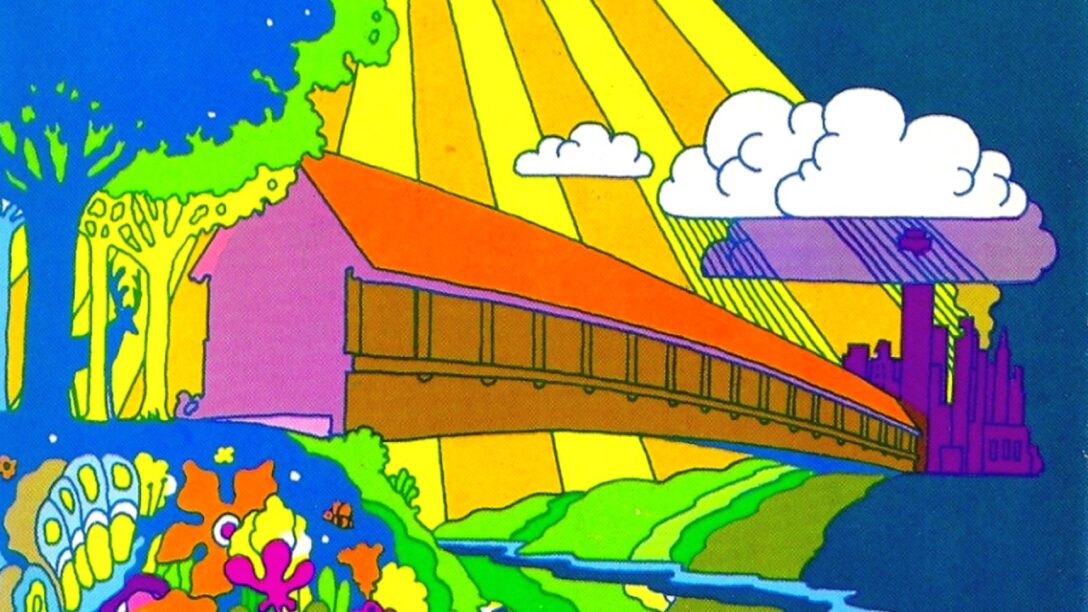
Published in 1948, the same year as Orwell’s Nineteen Eighty-Four, Walden Two is very different in tone. It was mainly popular in the ’60s, hence the psychedic cover art I suppose (see above).
Inhabitants of Walden Two feel like they are acting accordingly to their own free will, but really they are operating within parameters established through their psychological conditioning. Some might call that brainwashing, of course. Walden Two is either a revelation in how behavioural science is the key to society functioning at its absolute best (this is presumably what Skinner is trying to advocate). Or, it’s creepy AF.
Jenny Odell singles it out for criticism in last month’s book of the month, How to Do Nothing. She likens it to a ‘technocratic dictatorship’. What it boils down to, according to Odell, is one bloke in charge of everything. Including what people think and feel. Furthermore, no-one’s allowed to access ‘the Code’ on which their conditioning is based.
Time to revisit it, then. If you’re in Bristol, UK and would like to join an in person discussion of the book, come along to the next Bristol Utopian Book Collective meeting on 6 March 2023.
Astrid R. Abildgaard is a teacher and recent MA graduate in English and History from the University of Copenhagen in Denmark. In this article, she argues for using utopia not as a blueprint, but as a method for finding productive desires for a more just world, even in the most unexpected places.
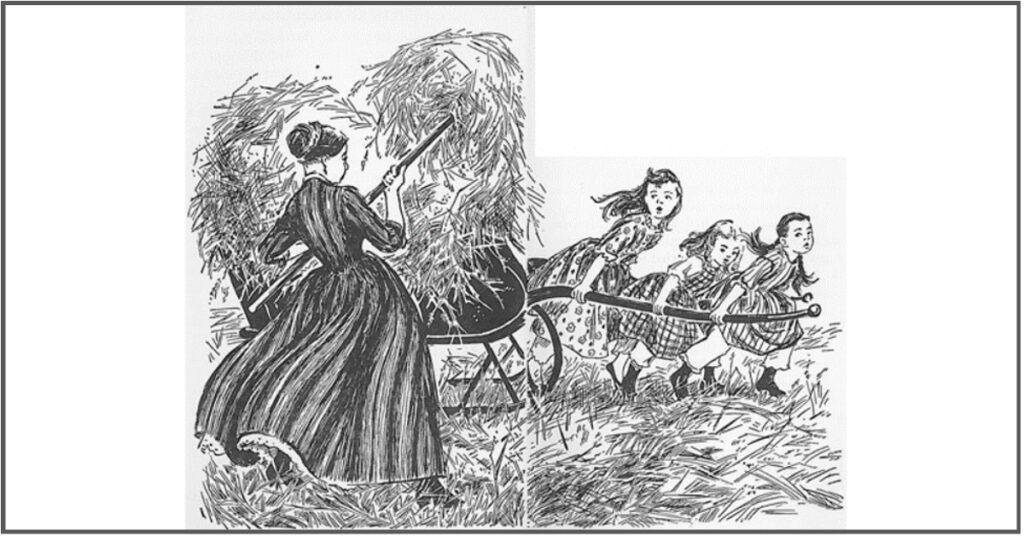
Gathering in the harvest at Fruitlands. Illustration by Flora Smith for The Story of Louisa May Alcott by Joan Howard.
When we think about the concept utopia, we usually imagine an island or a planet full of uncorrupted nature where people (or aliens!) have established a progressive social order. It is a fully physical space, even if it is imaginary. That is the type of utopia described by Thomas More when he first coined the term in 1516 by conflating the Greek eutopia (meaning good place) with outopia (meaning no place). In other words, More’s utopia is an ideal place that does not or cannot exist.
However, as the utopian theorist Ruth Levitas has pointed out in The Concept of Utopia (1990), utopia can also simply be a desire for a better way of living, which can become a catalyst for real change in some place. That type of utopia is one that can spring up in unexpected places – even in the seemingly traditional domestic novel of one of your favourite authors.
Utopian desire in… Little Women?
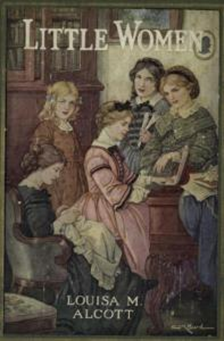
Ever since Louisa May Alcott wrote Little Women in 1868-69, it has been a staple of children’s literature all over the world. It is a universal yet traditional girls’ story about growing up, as we follow the four March sisters’ trials and tribulations on their way to womanhood and (one might say “of course”) marriage.
The story has also maintained its popularity among adults because of its multiple screen adaptations, most recently in the form of Greta Gerwig’s 2019 box office hit.
Gerwig’s adaptation is especially interesting because it recognizes what many readers had already picked up on: that the rebellious sister Jo is really a fictional version of Alcott herself – a fact that Alcott confirmed in her journals. Jo is an aspiring writer, who proudly vows to never marry and let a man stand in the way of her career. Accordingly, the traditional ending – in which Jo marries a much older professor – has confounded readers ever since the novel’s publication.
But Gerwig changes this much contested part of the story by blurring the lines between Jo and Alcott and having Jo bypass marriage to pursue literary success like her author (who, in fact, complained in her letter that her publishers made her marry off Jo “in a very stupid style”). In this way, Gerwig highlights not only the autobiographical connection between Alcott and her protagonist, but also the independence and feminism of both. By acknowledging this autobiographical connection, we can uncover another progressive note in the novel: one of utopian desire.
Alcott’s life at Fruitlands: a fruitless utopia
To do this, we need the context of Alcott’s life and writing. Few people know that as a child in the 1840s, Alcott participated in (or rather: was the victim of) her father’s experimental utopian society called Fruitlands. This community sought to transcend society’s evils like private property, trade, animal labor and self-indulgence through a focus on philosophical self-improvement. However, it lasted only seven months before it was brought to an end by the coming of winter and the men seemingly having forgotten to do the farming necessary to feed the community.
This childhood experience stuck with Alcott, and she wrote about it in her journals from the time as well as later in a less-known satirical short story called “Transcendental Wild Oats” (1873). In this story, Alcott ridicules her father’s unrelenting focus on philosophy and resulting disregard for the practical measures needed to sustain the utopian plan, which all resulted in an overburdening of the women in the community: Alcott herself, her mother and her three sisters.
The women save the community, first, by bringing in the harvest in the absence of the men, who have gone on a philosophical pilgrimage, and then by forcing the family to leave the doomed experiment and taking the practical measures to secure the family a more stable home. Alcott’s message in the satire is clear: lack of appreciation for women’s practical work is what undid Fruitlands, and women’s work for the community is what saved the family from impending dystopia.
Removing from Fruitlands Jan. 1844. Houghton Library, Harvard University.
Principles and practicality (and matriarchy)
When read in this context, Little Women displays a similar criticism of impractical utopianism. In the novel, Alcott reiterates Fruitlands’ ideals of self-improvement and self-sacrifice as guiding principles for the March family, but it is the reign of the mother, Mrs. March, that secures their practical implementation and prevents them from getting out of control. In the 11th chapter, “Experiments,” she lets her daughters skirt their chores – as an allegory to Fruitlands – letting them realize the necessity of practical work for the community on their own. Mr. March is notably absent throughout most of the story, and the happy, well-functioning home consists only of a community of women.
Alcott does not, however, let this childhood utopia stand unchallenged for long. Realistically, she depicts that the little women must grow up and eventually marry for money or love or both (or die like the sister Beth). Although Alcott idealizes the community of women throughout the novel, she seemingly does not want to get rid of men altogether; rather, she seeks to redefine their role in the household.
The three sisters that marry (Meg, Jo, and Amy) all take control of their marriages and teach their husbands how to help them with domestic chores and childcare while letting the women have their own agency and independence. Thus, Jo proclaims to her husband that their marriage will be one of equal responsibility and that she is intent on earning money herself. Alcott seems to argue that a happy marriage requires men and women to have equal responsibilities for domestic duties and equal amounts of independence in the family community. If that had been the case at Fruitlands, maybe they would have been fed, and the utopia would have had a chance.
A feminist yet practical utopian desire for gender equality
Alcott makes her desire for an altered relationship between men and women clear at the end of the story, when she depicts a functioning alternative to Fruitlands. The family celebrates Mrs. March’s birthday at Plumfield, the school Jo has established with her husband. Unlike Fruitlands, Plumfield allows for equal influence from the female and male elements (!), and Jo takes on the role of the matriarch of the community. The second half of Little Women, then, does not show a lack of utopian desire, but rather Alcott’s awareness of the limitations for women at the time.
Alcott criticizes her father’s unrealistic attempt at utopia in More’s sense while presenting an alternative in the form of feminist yet practical utopian desire for gender equality – even as she submits to the traditional ending in marriage. Thus, we can reconcile the conflict over the ending of Little Women without changing it to fit the independent feminism Alcott expressed elsewhere.
The example of Little Women reminds us not only of the feminist possibilities (and limitations) of 19th Century women’s fiction; it also shows us how we can use utopia not only as a blueprint for an ideal that is inherently impossible, but as a tool for discovering productive patterns of thought about a more just world, even in the most unexpected places.
Much of this article is based on Abildgaard, A. R. (2022). A New Biographical Interpretation of Louisa May Alcott’s Little Women: A Practicable Feminist Utopia? [Master’s thesis, University of Copenhagen]
Explore other guest posts on the Just Utopias blog here.
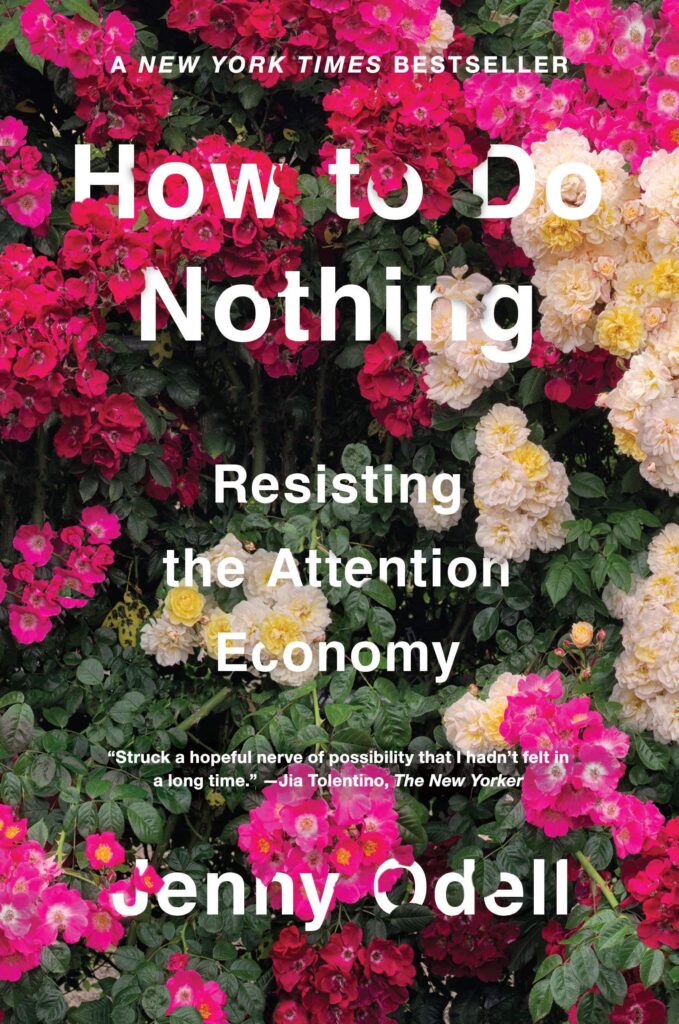
Book of the month for January 2023 is How to Do Nothing: Resisting the Attention Economy by Jenny Odell.
Jenny Odell’s book explores ways to refuse to let our every moment become monetised. She encourages resisting chasing the capitalist ideal of being ever more productive. In place of a crazed online existence building a personal brand and scrolling feeds arranged for us by algorithms, she advocates for re-engaging with each other and the physical world around us.
‘doing nothing’ – in the sense of refusing productivity and stopping to listen – entails an active process of listening that seeks out the effects of racial, environmental and economic injustice and brings about real change”
Jenny Odell, How to Do Nothing
Odell calls her book ‘an activist book disguised as a self-help book’. The book contemplates three routes to escaping the capitalist system. 1) dropping out 1960s style, 2) moving laterally out to things and people around us, and 3) moving downwards into place.
The book can be read as a utopian manifesto. Or is it a utopian plan of action? A way of being utopian in our increasingly dystopian world?
One of the best bits of news from 2022 is the revival of the Bristol Utopian Book Collective! UBC is up and running again.
We had seven great meetings in 2022. For a while we were the Bristol N. K. Jemisin fan club, when we read the Broken Earth trilogy one book at a time from July to October. (Hols in August, for the mathematically astute among you who will have spotted it took us four months.)
My favourite meeting of 2022 was in November, when about a dozen of us turned out for an animated discussion of Brave New World. Then, we headed through to the cinema for a screening of Neptune Frost. We meet in the cafe bar of the Watershed, an independent cinema in Bristol, UK. By fortunate coincidence the “exhilarating Afrofuturist anti-capitalist sci-fi-punk-musical” was screening at 9pm after our book group meeting at 7.
Utopias past and present
Brave New World is, of course, a classic. But would anyone still have anything to say about it, is it still relevant? Turns out yes, everyone had a lot to say. We could easily have done three or four discussions on this one book. Is it really a dystopia? Does it matter to not have free will if you’re happy? Why is art and culture better than centrifugal bumble puppy and electromagnetic golf? Who wouldn’t want to go to the feelies? Also, we got into some sticky stuff about eugenics, ableism and ageing.
I enjoyed going straight from Brave New World to Neptune Frost. It was like journeying from utopias past to utopias present. Neptune Frost defies easy explanation. To start off with my brain was furiously trying to work it all out as it went along but I had to let that go. I experienced the music and the action and the visuals. It is there now inside my mind and I get the feeling it may be changing things as yet unbeknownst to me in there. Unanimous goldmine!
What a difference 198 days makes
The official relaunch or revival of the Bristol Utopian Book Collective after lockdown took place in April 2022 as part of the People’s Republic of Stoke’s Croft School of Activism. On that occasion, two people arrived to the meeting. We had a wonderful discussion centred around The Deep by Rivers Solomon. But given the low turnout for what was a relatively well publicised event, I wondered if there was any appetite for continuing the book group.
I was already mulling over ideas for an offline, meetings-free Utopias Club. It involved newsletters and badges and I might still do it one day. But thankfully Emma and Nathan, who had joined me that day, were full of enthusiasm for the book group. I felt somewhat obliged to arrange another meeting. On that great and successful November evening only six months later I was grateful to them that I did.
It’s brill to have the group up and running again. If you’d like to join us, check out our upcoming events here.
In the autumn of 2022 I was working on a book review. To get a bit of headspace and exercise, I was cycling or walking to work on it at the Spike Island Cafe.
Spike Island is an area of Bristol (UK) almost entirely surrounded by water. The name suggests it should be fully surrounded, I know, but it ain’t. It has the docks on one side and on the other the ‘New Cut’. New in a geological sense, but this channel to divert the River Avon was dug over 200 years ago. It takes the tidal waters of the Avon in and out of Bristol while a series of sluices and such keep the docks at a constant level. The New Cut, by the way, is an absolutely massive channel, which is has to be, because the Avon has the second highest tidal range in the world.
Spike Island (the artspace) is housed in a former tea-packing warehouse. The industrial history of Bristol, like that of many British ports, is intricately connected with colonialism. Within the repurposed building there are artists studios and co-working spaces as well as exhibition spaces. Like all good art galleries, it also has a lovely cafe. That’s where I found myself reading ‘Dystopias and Utopias on Earth and Beyond‘ in preparation for writing my review. And it’s where I found out about the Associates programme.
Joining the Spike Island Associates programme
The Spike Island Associates programme is open to artists, curators, writers, designers and producers. There I was, writing notes in my book, preparing to write my review. I am genuinely writing something, I thought. I can tick the box that says I’m a writer. As I was writing an academic book review, I ticked the ‘academic’ box on the application too.
I joined the programme for the following reasons:
24/7 access to a workspace. This means whenever I can escape for an evening, or whatever time in the morning I manage to make it in, I can work without needing the cafe to be open
The money I would save in the cafe would more than pay for the membership fee. (There are kitchen facilities available by the workspace for making a cuppa or putting lunch in the mee-crow-wah-vay)
To be part of a community of artistically-minded people and all the potential cross-fertilisation of ideas that could bring
Some of the events open to Associates looked cool, including gallery tours and workshops
So those were my practical reasons for joining. But the biggest benefit to me so far, I think, has been that moment where I self-identified as a ‘writer’.
Like university, but for utopians
Previously, the structure that confirmed the validity of my work was university. Doing a Master’s degree brought a kind of legitimacy to my endeavours. What are you doing? Oh, it’s my MA research. However, I’ve continued to work long beyond finishing my degree. And while I have considered a PhD, lately I’m turning against university as a focus and locus for my work.
Becoming a Spike Island Associate has given me confidence to see myself as a practising thinker and writer. It has also been a way of securing some of the benefits I previously associated with university: a library-like workspace, a set of cohorts, mentors. As a utopian, I’m always pleased when I can find my own way of doing things when I’m uncertain about the system I’m working within. And becoming a Spike Island Associate has been one of those utopian moves for me this year.