How to fight the barriers of capitalism with poetry

Detail from artwork by Shiiku Collective as used to advertise their event fighting the barriers of capitalism

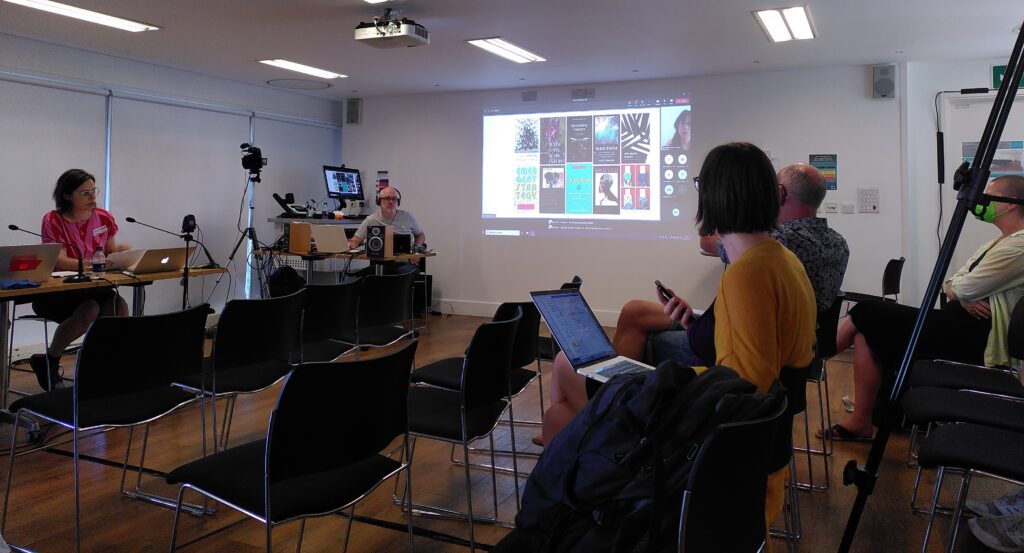
Anthropy≠Anthropocene, Shiiku Collective, 9 March 2023, Strange Brew, Bristol.

Carolyn Dougherty reflects on this event, which promised:

expressive spoken word on fighting the barriers of capitalism, interactive visuals co-created by our robot friends, ambient electronic beats with soft rainforest settings, and the voices of those ready to design a world that can be peacefully navigated by all.”

I’m a woman in my 50s, reasonably well read on utopia but perhaps not entirely up to date. I was hoping for fresh, young perspectives on living joyfully in a world we have (at best) badly and unconscionably damaged.

Instead, I heard several young people perform poems and songs expressing their desires in a world where they feel marginalised. The poems weren’t bad; in fact, I thought a couple were quite good. I’m glad I heard them. But, they primarily dealt with the individual’s inner world.

I hope everyone reading this has had the experience of engaging with a piece of art then stepping out into the world astonished at how your own perceptions have been changed by it. That kind of mental and emotional rewiring doesn’t happen when the art is focused on better understanding the artist.

Self-expression as a tool of late-stage capitalism

It is a genuinely powerful act to declare to others that we are proud to accept something about ourselves that our culture has taught us we should be ashamed of. But I dispute that it ‘fights the barriers of capitalism’ and offers a new vision of our world. Rather, it redraws those barriers further out, to enclose more of us.

Self-expression is something we’re taught to value, even revere, and it is valuable. But it also happens to be the ideal lever for late-stage capitalism to break into our interior world, to appropriate what resources still remain out of its control.

In the late twentieth century, the consumption machine encouraged us to express ourselves by buying things. Things that signified allegiance with whatever group we might want others to believe we were affiliated with. By acquiring, wearing or using things coded to belong to a certain group, we hoped to send signals that encouraged other people to assign us the status and group affiliation we desired to project.

What we now optimistically refer to as late-stage capitalism is much more sophisticated, and much less overt. The machine no longer creates and disseminates the rules for obtaining affiliative or distinctive things. Instead, we are more likely to self-define. We choose the signals ourselves, then inform others what these signals mean to us and should mean to them.

A collection, not a collective

It’s still the same mechanism, keeping us focused on who we are and how we identify. We remain preoccupied with both sending the correct signals and ensuring that others receive them in the correct manner. The capitalists win again, as this preoccupation, even obsession, with what we are signalling precludes any possibility that we might actually pay genuine attention to others.

This situation resulted in a grouping of artists that could more rightly be called a collection than a collective. Individual atomised people pinging packets of information to each other as a substitute for actually communicating, engaging, forming bonds, and creating the conditions for effective collective action.

Towards a post-capitalist utopian poetics

Art that focuses on one’s perception of the world paradoxically brings people closer together than art that focuses on one’s perception of oneself. Perceiving the world is something we all do, and an experience we can genuinely share. (I’m afraid not everyone is thinking about you.)

This kind of art is almost the opposite of the scientific method. Science attempts to organise and achieve an objective description of the world. Its goal is for us to have the same, repeatable, predictable experience. And economics, of course, likes to position itself as a science.

The goal of art is to help us have as many different experiences of the world as there are people. Relating to each other through sharing our experience of the world may be the most effective way to create the kinds of shared experience that could lead to collective action, and someday the creation of what could be a utopia.

Carolyn Dougherty is an economic historian and railway engineer currently based in Bristol. Her research and writing addresses the origins of capitalism and the development of the corporation in early nineteenth-century England. She is a member of the Utopian Book Collective.

Jack Halberstam’s Unworlding: An Aesthetics of Collapse

Jack Halberstam's Unworlding example one: Gordon Matta-Clark's Conical Intersect, 1975
Jack Halberstam's Unworlding example one: Conical Intersect by Gordon Matta-Clark
Gordon Matta-Clark, Conical Intersect, 1975. Orginal artwork held by SFMOMA. Source of image: https://aestheticamagazine.com/gordon-matta-clark-anarchitecture/

Jack Halberstam’s keynote ‘Unworlding: An Aesthetics of Collapse’ really was the absolute highlight of the Utopian Studies Society of Europe conference. But wait! You didn’t have to be there! A version of the lecture is available on YouTube so I wanted to share the details. It contains some real IDEAS about UTOPIA and I highly recommend checking it out.   

If you want to get to utopia, you can’t start from here

Halberstam opened with a huge challenge to the genre of utopia. We are limited in what we can imagine, he argued, bounded by what we know. Going forwards only carries over the problems of the present into the future. The necessary project, he suggested, is not worlding but unworlding.

The use value of utopia is often thought to be in prefiguring changes we would like to see in the real world. For Halberstam, this function is moot. There is no hope in bridging from here to the future. You must instead go back to dismantle the present.

Nothing matters

Halberstam used the art of Gordon Matta-Clark, shown above, to illustrate the creative potential of deconstruction. In carving a spiral through a building due to be demolished in Paris, Matta-Clark employed his architectural knowledge to create an absence of building. In this artwork, the artist’s material is nothing. It is art because of what has been taken away.

This work subverts the logic of capitalism, which demands things are made, possessed, consumed. As such, it also deconstructs the system we are caught in. Halberstam’s suggestion was this is a surer first step towards a new world than imagining a utopia.

Advocating for entropy

Moving ever further away from glossy utopian futures, Halberstam then set out his argument for embracing entropy. We will have to follow the logic of other lifeforms, he argued. Lifeforms that know what to do around ruination. Mushrooms, microbes, beetles all require decaying material as sustenance, and through processing what is rotten create the conditions for new life.

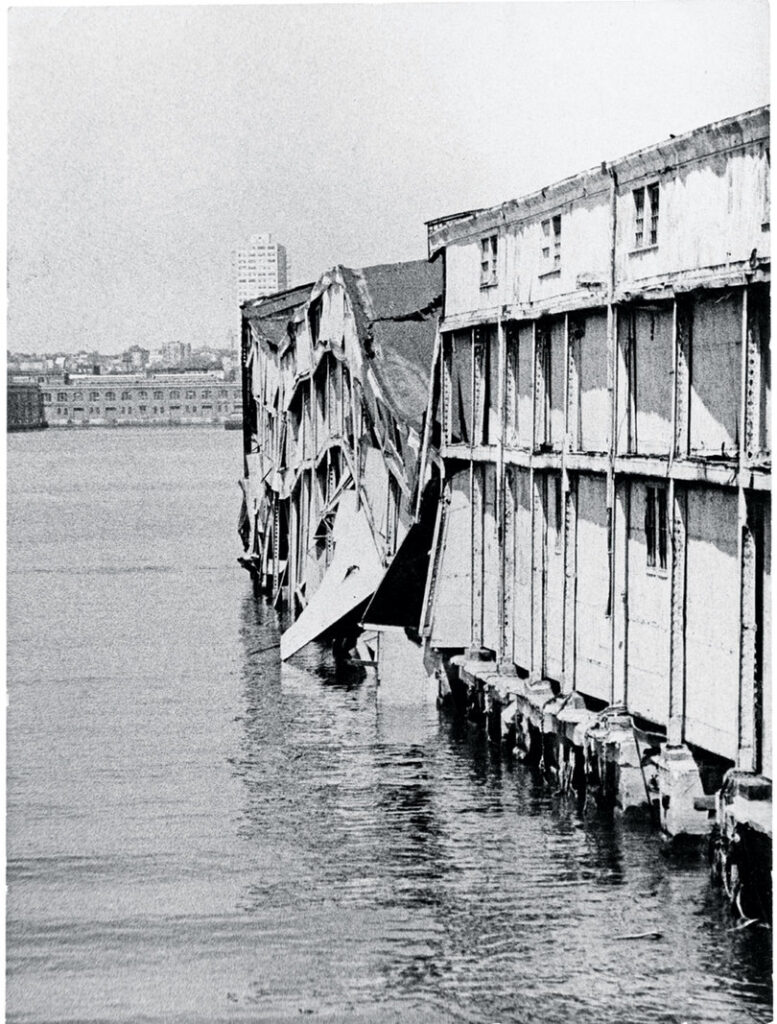
In discussing ruins and the marginalised lives that exist amongst, and may emerge from, them, he referenced the photography of Alvin Baltrop. Baltrop’s pictures captured the New York’s collapsing West Side Piers in the 1970s and 80s, and the gay men who cruised there.

Source of image: https://bronxmuseum.org/news/the-life-and-times-of-alvin-baltrop/

Jack Halberstam's Unworlding exampe two: pier photograph by Alvin Baltrop

Broken Earth

Jack Halberstam's Unworlding example three: The Broken Earth trilogy by N. K. Jemisin

Drawing his final example from literature rather than art, Halberstam went on to discuss N. K. Jemisin’s Broken Earth trilogy. His analysis centred the faction within the novel who want to see the end of the world, not save it. These characters are some of those who have been marginalised and exploited by the prevailing society. Halberstam drew parallels with Afro-pessimism, asserting the only way out of white supremacy is to destroy the world it has built. By implication, a utopianism that aims to repair the existing system would be a neo-colonial project.

After attending the lecture, I re-read the last two novels of the Broken Earth trilogy. I was left wondering whether the ending of the trilogy sustains the Afro-pessimist reading.

— SPOILER ALERT — Skip this section if you haven’t read The Stone Sky in its entirety!

Nassun, who had wanted to all-out destroy the world, in the end executes her mother’s plan to fix it. In the aftermath it is acknowledged that, despite the fix, the current Season will continue for some time. While it is hoped node maintainers will no longer be required, just exactly how things will work out remains uncertain.

The result is certainly an undoing, yet it isn’t total destruction. Is this a large repair job or are things are sufficiently unwound to start again?

Watch online

You can find a version of Jack Halberstam’s lecture Unworlding: An Aesthetics of Collapse online, see below.

Review of Twoty-Twoty-Two (2022): Utopian Studies Conference

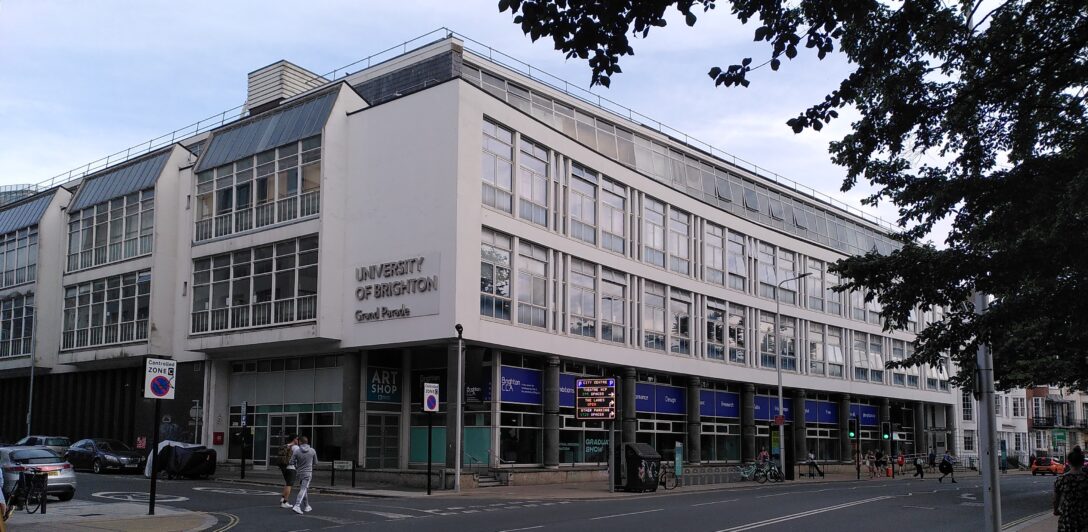
Photograph of utopian studies conference venue at University of Brighton
Conference venue: University of Brighton

The thing that took me farthest out of my comfort zone in 2022 was attending the Utopian Studies Society conference. I thought it would be nice to have a few days away to discuss all things utopian but I was wrong. I stretched my elastic too far just to get there. It was my first time travelling on my own and travelling much at all since the pandemic and having a child (both things that have tied me to home over the past few years). Having to then leave my room and attend events was so hard. This is despite my room (in student halls) being unbearably hot and depressing.

Yes, this was another USS conference in a heatwave, like the previous one in Prato, Italy in 2019 where we discussed utopia, dystopia and climate change in 40 degree heat (Celcius, folks). Just the thing to make discussions feel urgent and hopeless at the same time.

Utopia and the Plantationocene

My talk was deliberately provocative, which is something I like to do. We’re all in a room together so let’s provoke a bit of conversation. I stood up and argued that the logic of utopia is the same as the logic of the plantation. I said:

  • The foundation story for Utopia (the place) in Thomas More’s Utopia (the genre-founding book of 1516) is settler-colonist fantasy. King Utopus conquered the land of Abraxa, named it after himself, and ‘brought the rude and uncivilized inhabitants into such good government, and to that measure of politeness, that they now far excel all the rest of mankind’
  • More was not only inspired by the colonisation of North America by his fellow Europeans but contributed to the ongoing settlement of the continent. In Karl Hardy’s words, ‘Utopia clearly articulates the settler colonial doctrines of terra nullius [no man’s land], vacuum domicilium [unoccupied home], and inane ac vacuum [idle and waste] which were used by European powers to establish legalistic grounds […] for expropriating the supposedly unhabited land’
  • Donna Haraway and Anna Tsing describe how the Plantationocene – the era of the plantation and its transformative effects upon our planet – started at the same point in history. Plantations were a new form of agriculture designed by Europeans specifically for slave labour in the New World
  • More’s Utopia reflects and expresses plantation logic, just as surely as it is inseparable from the colonisation of America. Utopia (the place, the book and the genre) is about establishing systems of control to obtain a perfect outcome. Further, it imagines the means of enforcing the ways of being required to perpetuate said perfect state. The logic of utopia is the logic of the plantation

And the response? No-one challenged me. No-one even batted an eyelid. They nodded, apparently agreed, and carried on with the utopian studies conference.

Decolonising Utopian Studies

The colonialism at the heart of utopia is an open secret in utopian studies. Some scholars do, however, address it directly. On a panel titled ‘The Past and Future of Utopian Studies’, Caroline Edwards spoke on ‘Decolonising Utopian Studies’. It was undoubtedly one of the most important contributions to the conference.

Dr Caroline Edwards presenting at the utopian studies conference

She started out with a list of sources, including:

She asked why these texts and authors are not being talked about in utopian studies. And why black speculative imaginaries are not coming to utopian studies. Why are we not citing them and why should they bother citing us?

Funding Utopia

I suspect this might come down to studying an essentially colonialist genre within a colonialist institution – the university. Why would anyone exploring anti-colonial ways of being want to come towards that? Later on the same panel, Adam Stock highlighted a key obstacle for going the other way: funding. Anyone working within utopian studies on this area is trying to get funding from the very institutions that the research will criticise.

As someone on the periphery of academia, the poolside if you will, this conference made me think twice about jumping back in. Especially when Caroline Edwards talked about how adrienne maree brown (idol) could not do what she does if she was working within academia. She could not do her critical writing and thinking alongside being a doula and a poet plus do teaching and research in the form that academia demands. It made me think about what the real, important work is and where it happens. And those thoughts are ongoing.

From lemon balm tea in a Martian house to lemon verbena in the woods

Exterior shot of the Martian house in situ in Bristol, UK, September 2022
The Martian House in Bristol, UK, September 2022

Sometimes you don’t know how you feel about something until the morning after. Yesterday I visited a prototype Martian house, learnt about growing plants hydroponically and participated in a ‘plant-bathing’ meditation and tea ceremony. We picked lemon balm leaves from the indoor garden to make our tea.

Over tea, we talked about how extraordinary growing plants would be for the wellbeing of anyone living on Mars.

How the plants would be the only green thing they would see on that planet.

About ‘viriditas’, a term coined by Hildegard von Bingen (everyone’s favourite C12th abbess and also a musical genius) to refer to the life force and vitality of green leaves and also within us.

How witnessing a plant grow would be a measure of time in an alien environment, where days, years and seasons are unlike those on Earth. How the plants would become companions, and how one Russian cosmonaut became particularly attached to an onion he grew in space, effectively keeping it as a pet.

About shinrin-yoku, the Japanese practice of forest-bathing (like sun-bathing but under the trees) and the discovery of phytoncides. These chemicals, emitted by plants, affect our mood and health, offering a rational explanation for why being amongst plants can make us feel better.

From a Martian house back to Earth…

A poster reading 'CAN DESIGNING FOR MARS GIVE US THE PERSPECTIVE WE NEED FOR LIVING ON EARTH?'

The Martian house has been created by artists Ella Good and Nicki Kent in collaboration with Hugh Broughton Architects and Pearce+, with Katy Connor bringing the plants. Its purpose is not an earnest attempt to get us to Mars. It’s more a thought project in what we really need and how we can fulfil our needs sustainably, which is most immediately applicable to our lives on Earth.

It’s fascinating, and a credit to the impact of the project, that the day after visiting I find myself in the woods. It wasn’t my plan for the day; my usual luxury is to go to a cafe to write and enjoy some form of rainbow latte (matcha, tumeric, yet to try beetroot but intrigued).

Today I woke up and felt like walking to the woods. This was fairly impractical because I had work to do. But I looked at the weather forecast, and it looked dry. I considered how we’re getting towards the end of September and there won’t be many more decent days before winter. So I packed my writing things and prepared to endure weird looks from dog-walkers for sitting using a laptop in the woods.

All those things we talked about being valuable on Mars: the green, the viriditas, the seasons, the companionship of plants, the phytoncides… they’re valuable here too. And I woke up wanting them here on Earth. I took lemon verbena leaves grown at home, brewed them into tea, and took it with me into the woods.

And it was an apt place to work on my The Word for World is Forest presentation!

Three utopian things bringing me joy this month

As I mentioned in my last post (the one before Rob Bryher’s article on car free cities and environmental justice), I haven’t been reading novels lately. Since admitting this, I’ve felt more able to focus on what I am currently enjoying in the world of utopia, and consciously taking pleasure from those things. This includes essays, online talks and events, and adding to my reading list for that future day when the book lust kicks in again. It’s a lesson in being led by what I enjoy. So here’s my round up of the utopian things bringing me joy this month.

1. Adding to my awesome utopian reading list

Loyal followers of the blog will know I have an awesome utopian reading list focusing on Afrofuturist, African Sci-Fi and Black Utopias. I featured it back in my inaugural blog post.

This week I’ve added the following:

Essays by Eugen Bacon

Bacon shared her essay ‘Black Lives Matter – The Rise Of Future Forms, Genres and Modes’ on twitter this week. The essay is something of a wormhole, leading to more of her own essays and a whole host of recommendations of work from other Black writers. Particularly high on my list are the New Suns and New Suns 2: Original Speculative Fiction by People of Color anthologies edited by Nisi Shawl (more from Shawl below).

Octavia’s Parables

I read Octavia Butler’s Parable of the Sower in July 2019 during an extreme heatwave in Europe. I was in Prato, Italy for a conference on utopia and climate change and it was 39℃ (103℉). We were melting while we talked about climate catastrophe and apocalypse, the air conditioning failing around us. Trump was in power in America. It was all too real.

I really want to read Parable of the Talents but now we’re living through another dystopia (yes, the pandemic) I’m worried about finding it a bit much. This is where I see Octavia’s Parables stepping in.

This podcast (which I missed off my utopia and climate justice podcasts list), hosted by Toshi Reagon and adrienne maree brown, takes Parable of the Sower (season one) and Parable of the Talents (season two) one chapter at a time. I feel that in this supported way, chapter by chapter, I could read Parable of the Talents, at what is undoubtedly a pertinent time to do so. Based on brown’s key note discussion of Butler at the New Suns online literary festival, I know she has both a deep love of Octavia Butler and doula skills for guiding people through potentially traumatic experiences. So I’m going to trust in the podcast, is what I’m saying.

Prato. It was sooo hot.

2. Sitting in my PJs watching authors talk about utopia

Here’s a zero effort way to indulge in all things sci-fi and utopia. I treated myself by making time to catch up on this recorded event from February 2021, featuring Meg Elison, Nalo Hopkinson and Nisi Shawl, with Terry Bisson as moderator.

Highlights for me were:

  • Everyone being super relaxed and chatty
  • Nalo Hopkinson on the pandemic – “I didn’t want to be living in an Octavia Butler novel!” – and on the mainstream – “I’m not going to get normal anytime soon”
  • Nisi Shawl on Everfair as a utopia: “Although, Everfair, the people in it are trying to create a utopia, I think of it more as the process of utopia rather than as the goal that everyone gets to. It’s getting there that is the important thing, not having arrived”
  • Meg Elison on her upcoming utopian noir novel, The Snatch (does this mean the same in the US as in the UK?)
  • Meg, Nalo and Nisi putting Terry straight on contemporary publishing (deadlines aren’t elastic and no-one’s got an expense account)

3. Attending live online events and feeling part of something exciting

Back home in Bristol, the People’s Republic of Stokes Croft have been running a three week School of Activism. One class, hosted by Invented Futures, was on ‘Speculation, Visionaries and Modern Mythologies‘. Invented Futures is a collective based at Spike Island in Bristol looking at new technology and the stories that drive the tech we invent. (That’s my interpretation of what they do anyway, I’d like to talk to them and find out more!) One of the speakers was Katie Stone of Utopian Acts, a collective I’ve collaborated with before. So I felt at home on several accounts and relished the discussion.

One text that Katie brought up was Nalo Hopkinson’s Midnight Robber. She spoke of how the book contrasts the technological knowledge of two different worlds, one hi-tech and the other seemingly primitive. Since watching the Stranger Than Fiction roundtable I was thinking I wanted to read something by Hopkinson. As usual though, I couldn’t pick which book to start with. But here was Katie talking about Midnight Robber… Is this a sign, I thought?

And do you know what, I think it was a sign. I think I’ve chosen my next book to read. I might be about to get back into reading, spending delicious quiet hours with a book, tea and quite possibly also chocolate. I’ll let you know how it goes.

North America: a failing colonialist utopia?

Pandemic. Wild fires. Climate crisis. Biodiversity crisis. Rise of the far right. Sometimes, it seems like things aren’t going so well.

I heard an Indigenous viewpoint on the multiple crises facing North America (and the world) from scholar Dr Kim TallBear at the ASLE (Association for the Study of Literature and Environment) Nearly Carbon Neutral virtual conference in July 2020. It was enlightening, perspective-shifting stuff. I want to share with you some of the thoughts that have stayed with me ever since.

What TallBear believes she is witnessing in the US is “the implosion of the western colonial project”. In other words, the current crises can be seen as catastrophic consequences of settler-colonialism. Consequences of disrespecting and destroying the land and its peoples: humans, plants, animals, minerals and water. Consequences of arriving on an already occupied continent and perceiving it as an empty page on which one is entitled to design a new world.

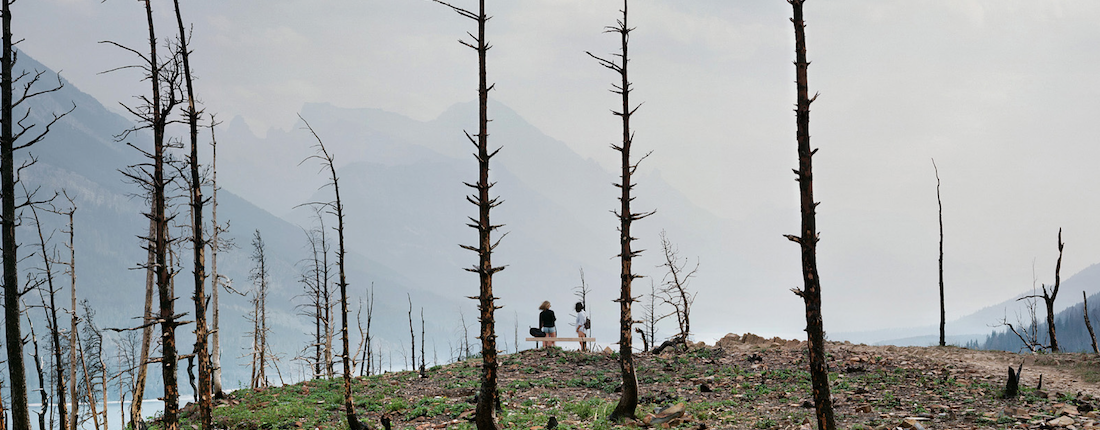
Rutkauskas – Burned Hill. Source: http://ehc.english.ucsb.edu/?page_id=20002

Colonialism as a utopian project

Before hearing TallBear’s talk, I hadn’t recognised the utopian impulse within colonialism. But it doesn’t take much examination of the concept of “the western colonial project” to recognise it as a utopian project.

There is a dark side to utopia, and that is when one person or group’s vision of an ideal world is enforced upon others. The history of Europe in the 20th Century gives us two clear examples: Stalinism and Nazism. Through these I already understood there can be a fine line between utopianism and authoritarianism. Now I see another terrible example of utopian world-building in the violence of settler-colonialism.

For Indigenous People across the American continents, mortality rates due to disease, starvation, forced assimilation and war resulted in estimated 90% mortality rates. For my own people, the Dakota, we now have seven and eight generations of Dakota people who have lived in a Dakota post-apocalyptic world. Indigenous Peoples are still mourning, still living in scarcity, still rebuilding from the quieting of our ancestors’ worlds.

Dr Kim Tallbear

When utopian thinking can lead to genocide and apocalypse, is it only right to give up on utopia?

Utopia as a decolonial project

The realisation that colonialism is a utopian project led me to wonder whether utopia is always a colonial project. I think there are certainly many examples of utopias with colonial logic at their heart whether they realise it or not – many most probably not. These include green utopias with benevolent creators, who nevertheless want to impose their idea of the optimum way to live upon whole cities, countries, continents, planets.

However, there is more than one way to be utopian. There is the being an architect of a superior world way, which is the potentially authoritarian, colonialist, troubling way. Then there is another way where you simply refuse to accept the conventional limits of what is possible and dare to imagine otherwise. This second way is, I think, too important to give up. In fact, it could be crucial to decolonisation.

In her address, TallBear explained

As a Dakota, who has always struggled in a world where an anti-settler state ethic seemed unspeakable, privileging the Dakota Oyate – the people and worldview – was deemed impossible throughout much of my life. Unrealistic, mythological.

Dr Kim TallBear

It is this kind of deemed impossibility that can be undermined by the second type of utopian thinking. Being utopian in this way means being alive to the possibility of things being different from how they currently are. Knowing that things could be different then puts you in a position to ask critical questions. Is this, which my society tells me is impossible, really impossible, or could it be possible after all? Is that a real boundary, or will my hand go right through it? Can I think differently to how I thought I had to think?

Radical hope

TallBear senses a “radical hope” within the multitude of crises facing the US and Canada.

I’m not celebrating what’s happening to the planet and to our non-human relatives and some of the most vulnerable humans […] but I think there are opportunities for us to think about the demise of certain intellectual systems that are incredibly violent as we are reckoning with earthly systems agitations against anthropogenic change.

Dr Kim TallBear

I agree there is hope where the demise of one worldview allows room for others, and I see the thrilling potential for decolonised utopias to rush into the intellectual space left behind.

Dr Kim TallBear is enrolled Sisseton-Wahpeton Oyate and descended from the Cheyenne & Arapaho Tribes of Oklahoma. She is Associate Professor, Faculty of Native Studies, University of Alberta. You can see her address in full below.

INVASION documentary

Elsewhere at the same conference, I attended an online watch party of the short film INVASION. This documentary follows members of the Wet’suwet’en Nation as they protest against the Canadian government permitting oil companies to lay pipelines across their land. The land in question has never been ceded to Canadian settlers. This film brought it home to me that colonialism is not an historical event or a time period that has passed. Colonial logic still prevails and this is why we need utopia. We need better ways of thinking, or new “intellectual systems” to use TallBear’s term.

The Way to Utopia in an Environmental Crisis

My own contribution to the ASLE conference was a paper on Ursula K. Le Guin’s Always Coming Home. The paper, which you can view below, looks at how in Always Coming Home Le Guin manipulates the genre of utopia in order that the form of her book can be true to its feminist, ecological content. I also wrote an article on this subject, which you can read here.