Fictional utopian languages: Part III – Asa’Pili, Láadan

Part III of this three part series, in which Nathan Taylor-Gray explores fictional utopian languages and the utopian ideals of their speakers. If you missed them, here are Part I – Utopian, Houyhnhnm and Part II – Speedtalk, Pravic.

Sketch of a bolo, a utopian settlement where the fictional utopian language of asa'pili might be spoken
Source: https://theanarchistlibrary.org/library/p-m-bolo-bolo

By the time we reach the 1980s, fictional utopian languages were being invented every year or two. At this point it becomes a challenge to know what to include and what to exclude.

The criteria I’ve applied is to focus on fictional utopian languages that perform specifically idealistic functions, such as describing different ideas of ownership, relationship arrangements, or more equitable systems of economics. I’ve also excluded any language that doesn’t include examples of words in the language. This is why some notable fictional languages don’t qualify.

The Expanse’s Belter patois, the Loonie slang of Heinlein’s The Moon Is A Harsh Mistress, or even the evolved English of Le Guin’s Kesh in Always Coming Home aren’t particularly ideological, even if some of those using it share a utopian ideology. Likewise, the Newspeak of Orwell’s Nineteen Eighty-Four is promoted by its fictional society as utopian, but even they admit in secret it was designed for very dystopian ends. Tolkien’s Elvish tongues in The Lord of the Rings were undoubtedly a major influence on the creation of modern fantasy languages. But the Elvish world – while it may be seen as ideal to some – is also exclusionary, with the vocabulary itself not being particularly egalitarian.

The inventors of the two fictional utopian languages to be discussed in this post were intending not just to reflect the ideology of its speakers, as previous fictional utopian languages had done, but to introduce a tool for effecting change in the real world.

Asa’Pili

The fictional utopian language of Asa’Pili appears in Hans Widmer’s 1983 work Bolo’bolo. The book is an anarchist utopia with a very detailed description of community arrangements, but without much in the way of story.

The book is written in retrospect, after the world has been long organised into autonomus, semi-self sufficient communities called “bolos”. It begins in 1984, when Bolo’bolo pamphlets raising awareness of alternative ways of living spread across the world. This focuses the discontent of many people and soon results in the subversion of established systems of government. By 1987, international capitalist systems collapse. The next year, the whole world lives in bolos.

The book is not only a description of a possible utopia, but gives us a new vocabulary in which to understand how it is organised.

Asa’Pili vocabulary

Altogether, Widmer defines 30-40 words, which it is implied are just some of the words from a new universal language. These don’t just cover the unique concepts of the book, but also common words such as ‘person’, ‘food’ and ‘home’:

  • Ibu – person. Although Widmer translates as ‘man’ he seems to intend to encompass all genders
  • Kana – a group of 15-30 ibus
  • Bolo – about 20 kanas, so 300-500 ibus, plus guests (potentially 30-50)
  • Kodu – the agricultural base of a bolo
  • Sibi – practical buildings of the bolo
  • Ganu – meeting places for the bolo
  • Tega – township of 10-20 bolos
  • Dala – assembly of a tega
  • Dudi – delegates to a dala
  • Vudo – a county, around 400 bolos or 200,000 ibus
  • Vudo’dala – assembly of a vudo
  • Sumi – the largest practical unity for bolos and ibus. Can comprise an indefinite number of bolos, or several million people
  • Sumi’dala – assembly of a sumi
  • Asa – the whole world
  • Asa’dala – assembly of the asa
  • Yalu – food, to which everyone is entitled
  • Gano – a room, to which everyone is also entitled
  • Kana – a permanent home
  • Fasi – travelling, which can be done for as long as one wishes, taking a gano in another bolo wherever one visits, without encountering any borders beyond geographical ones
  • Sila – hospitality and tolerance, afforded to everybody
  • Taku – a container every ibu gets from their bolo, measuring 50x50x100cm, to contain their entire personal belongings. The size is similar to a small suitcase, presumably enabling one person to carry it without much inconvenience
  • Nami – the principle that “Every ibu can choose, practice, and propagandise for its own way of life, clothing style, language, sexual preferences, religion, ideology, opinions, etc., wherever it wants and as it likes”
  • Kene – common enterprises that carry out the distribution of essential resources in addition to those each bolo produces through its agriculture
  • Pili – language

The language combines words to make new ones, such as asa’pili (world language), fasi’ibu (traveller) and yalu’gano (restaurant).

The Asa’pili alphabet
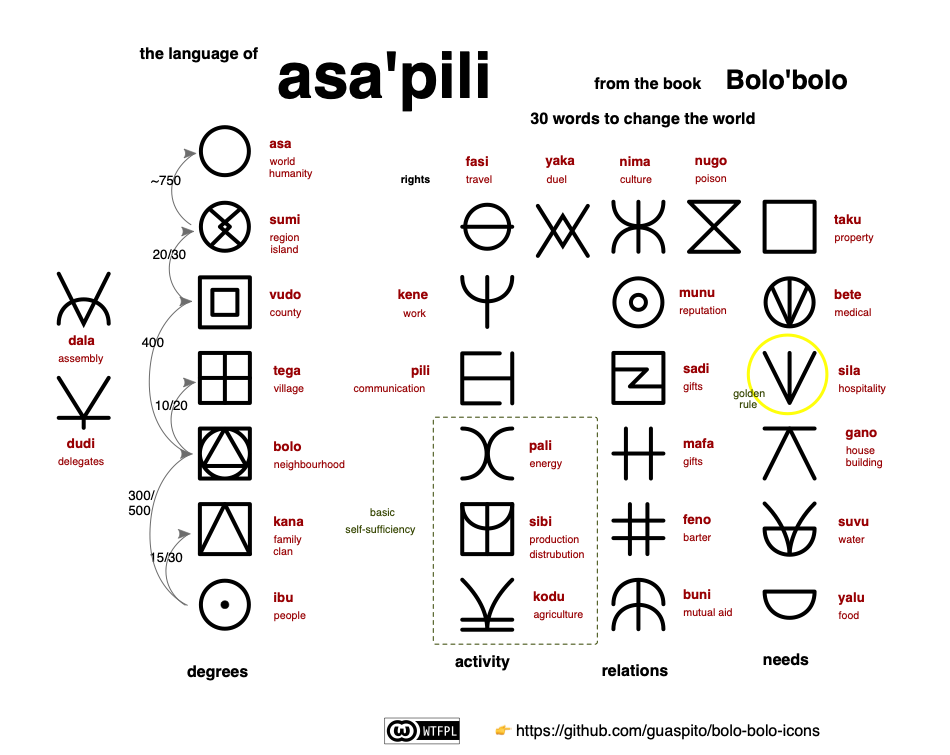
Asa’pili has a much more concise alphabet than English. It is composed of a gang of 18 sounds (+ pause). Some of the symbols seem hieroglyphic. For instance, taku looks like the box it represents, and gano looks like a tent and symbolises housing.

Why Asa’pili?

As for his reasons for coupling his ideals with a new vocabulary, Widmer recollected and explained:

The original idea for creating this weird secret language came up because the European left-wing terminology was no longer viable. Nowadays when people talk about communism, that’s Gulag, no one wants to hear about it. … It is easier to simply say I am for bolo’bolo, and then everyone starts to think of the things all over again, to re-think them. … I invented this language. Bolo’bolo really means nothing other than communism. It is simply the translation”

Although Widmer admitted that Bolo’bolo started as “a mere collection of wishes”, he was hopeful that it could be a practical and realistic solution. “Bolo’bolo can be realised world-wide within five years” he claimed. Maybe those five years are long overdue, but hopefully we have five years left to do so. If society ever does go ahead and create something similar, thanks to Bolo’bolo they will have the words to do so.

Láadan

The fictional utopian language Láadan was created by Suzette Haden Elgin before she wrote the book that introduced it to the world, Native Tongue. Elgin was a language professor and developed her language with the aim that women could express their unique perspectives and experiences. She felt our patriarchal society had influenced language in ways that disadvantaged women, affecting not only their vocabulary but also their thoughts.

Elgin was also a science fiction writer and extolled sci-fi as a medium for women’s liberation. Native Tongue was published in 1984, with a grammar and dictionary following the year after. Unlike Le Guin’s fictional Pravic, Láadan was intended to be used as a real and unique language.

Elgin said she had the idea because, after speaking about the problems women have with language, she was repeatedly asked “If women aren’t satisifed with the language they have, how come they’ve never made up their own?”. In an interview she explained:

[I] was distressed by that question; I wasn’t aware at that time of the language constructed by Hildegard of Bingen, for example. It seemed to me that it would be useful for me to do a language, and specifically a language designed to express female perceptions – just so that I could say that it had been done.”

Women Writers.net

The presentation of Láadan in Native Tongue

Native Tongue is set many years after amendments to the US Constitution by conservative Christians have repealed all rights for women. We follow the story of Nazareth Chornyak, a woman who is the most gifted linguist of her age. While such “lingoes” are essential to human/alien communications, women are treated as children by the misogynist society of the time. Once they are too old to give birth, they are retired to the “Barren House”.

It is in the Barren House that Nazareth and her fellow women develop their own uniquely female language. Their purpose is to empower young women to fight against their oppressive culture. In a conversation within the book, a woman named Aquina muses about its potential:

Suppose we begin to use it, as you say we should do. And then, as more and more little girls acquire Láadan and begin to speak a language that expresses the perceptions of women rather than those of men, reality will begin to change. Isn’t that true?

“As true as water,” Nazereth said. “As true as light.”

Native Tongue, p.250

Láadan vocabulary

The language has a multitude of words for women, menstruation, pregnancy, menopause, love and sex. Many words, and all pronouns, are gender neutral, until a gendered suffix is added. Elgin suggested male and female suffixes. Other proponents of the language have since suggested non-binary suffixes, as well as expanding LGBT+ specific terms.

The vocabulary offers other insights into the utopian themes of community, organisation and the unique relationships and connections that form in the subculture described in Native Tongue. For example, their word for community means not just an arrangement or collection of individuals, but also a feeling of belonging. Likewise, their word for family can refer to birth parents and siblings, but also people connected closely who create adopted family relationships.

There are specific terms for homosexual relationships, which are valued within the culture. In other ways it is more traditional: marriage is a monogamous arrangement between men and women, and children are raised by a parent. Yet the word for marriage insists it is something two people do together. As the dictionary states: “Láadan wouldn’t allow ‘X married Y or ‘Y married X’, which presupposes that marrying is something one person can do to another. It has to be a joint action, done together.”

The women are treated as chattel and assigned places to live and work, until they are sent to the Barren House. As such, current property relationships don’t quite apply. But the language still has words for possessing and owning, especially when it comes to personal items.

Clarity of communication

Being understood clearly is very important to the speakers of Láadan. An additional feature of the language is words to indicate the intent of your statement, e.g. whether in jest, in anger, or as a question. It also has words to indicate your own conviction in your statement, and whether or not you have a trusted source for any information you divulge.

Elgin was convinced of the utility of her language. She was therefore disappointed it was not adopted more generally outside of her novel. In a 2007 interview she disclosed that on the basis of Native Tongue being a thought experiement her own hypothesis – that within ten years women would either adopt her language or invent another one – had been disproved. However, Láadan does continue to have a life outside of the book.

Other sources of information about Láadan

As a fully developed language there is more to set out than can be described in this blog post. Look out for a bonus post coming soon with examples of the vocab. More information can also be found at http://www.laadanlanguage.org/.

Summary

In the novels covered in this series, the invented languages have specific purposes. The need to find new words to express the ideals of their new society, for instance. Or, the need to rid themselves of negative words from the old society that undermine their new ideals.

This gives the authors a reason to introduce new words that address the inadequacies of English. Especially problems with possessive terms for how humans relate to each other and things, and gendered words that don’t account for the complexity of the identities of their characters, or the dynamics of their relationships.

The future of utopian languages

The increase in fictional utopian languages has come with the increase of new utopian literature. This has been written for a number of reasons, such as:

  1. A new generation has grown up with the utopias of the ’60s
  2. Whereas political groups reacted negatively to earlier utopians or saw them as frivolous (Marx and Engels were particularly critical), there is now more acceptance that positive fictional portrayals of possible futures may inspire and foster greater ideological understanding and even prompt revolutionary action
  3. With the advent of the web and new ways of finding readers, this makes it easier to reach those who share an interest in utopian literature or the ideals related to it
  4. Our own age has specific challenges (or those challenges have become more severe or we are more aware of them) which inspires writers to come up with new solutions (or apply old ones in new relevant ways)
  5. Authors from other cultures and non-traditional backgrounds who now have greater access to potential readers, are seeing it as a means of expression, bringing their own unique viewpoints and voices

For all these reasons and more I would expect the trend of creating new fictional utopian languages to continue, as well as further development of the ones we have into real world constructed languages. Perhaps some of the words these authors have created will yet make their way into slang or even common usage. But even if they don’t, the ideals behind them will continue to prompt new ways of envisaging and building the future. New words will always be part of that utopian process.
Fictional utopian languages: Part II – Speedtalk, Pravic

Ithkuil text

Part II of this three part series, in which Nathan Taylor-Gray explores fictional utopian languages and whether they reflect the utopian ideals of their speakers. If you missed it, you can catch up on Part I here.

A textual example of Ithkuil, utopian language based on Robert Heinlein's Speedtalk
Ithkuil, an invented language inspired by Robert Heinlein’s concept of Speedtalk in his novella Gulf.

Speedtalk

The two languages discussed in Part I – Utopian and Houyhnhnm were supposed to be native and natural to the cultures described. Speedtalk is different, as it is the first to be constructed within the fiction by a group with utopian aspirations.

The fictional language ‘Speedtalk’ features in Robert Heinlein’s 1949 novella, Gulf. It is the invention of a group called the ‘New Men’. Intellectually superior to normal humans, the New Men want to keep their technology separate. Ultimately, they plan to create a new species of humans like themselves. Our protagonist Joe, a secret agent, is introduced to the language by love interest Gail, who is one of the New Men [apparently they admit women, ed.*].

The New Men cite as inspiration the real life studies of C.K. Ogden and I. A. Richards and their 1923 book The Meaning of Meaning. “Ogden and Richards had shown that eight hundred and fifty words were sufficient vocabulary to express anything that could be expressed by ‘normal’ human vocabularies,” Heinlein has them say. These fictional New Men set about distilling these words into a “hundred-odd sounds, represented by the letters of a general phonetic alphabet.” Using variations in these sounds, including “length, stress, pitch, rising, falling,” the New Men create a language where “one phonetic symbol was equivalent to an entire word in the English language, one Speedtalk word was equal to an entire sentence.”

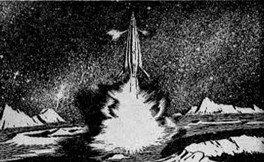
Black and white illustration from Gulf by Robert Heinlein showing a rocket blasting off from a crater marked moonscape

An ideal language?

Heinlein’s New Men have three main arguments for the ideal nature of their language:

  1. In Speedtalk it is difficult not to be logical, whereas supposedly “‘Normal’ languages, having their roots in days of superstition and ignorance, have in them inherently and inescapably wrong structures of mistaken ideas about the universe. One can think logically in English only by extreme effort, so bad it is as a mental tool.”**
  2. The language is incapable of paradoxes because “it did not contain the unreal distinction between nouns and verbs,” and could more accurately express “space-time events and relationships between words.”***
  3. Its efficiency lengthened the mental life of those who spoke, read, wrote and thought in it. Or at least, compressed substantially more intellectual experience into the same amount of time. The New Men claim “Any man capable of learning Speedtalk had an association time at least three times as fast as an ordinary man.”
Black and white illustration from Gulf by Robert Heinlein showing a pair of hands holding and writing on what looks a cannister that will be sent along a pneumatic tube, with a skull floating behind on a black background. Sinister.

New language, new tech

Speedtalk didn’t just speed up thoughts in the human brain. It also required a special new bit of tech to keep up with reading and writing. A “dictaphone-typewriter-printing-press combination. The machine’s analysers recognized each of the thousand-odd phonetic symbols.” This was combined with “a ‘librarian’ machine that could ‘hear’ that portion of Speedtalk built into it as a filing system.” With these innovations, the New Men had no need of writing in the traditional sense at all.

But, for all the progressive aspirations of their language and technology, aspects of the New Men’s society seem backwards and even dystopian today.

Utopian or dystopian?

The New Men consider themselves a “different breed” and better form of humanity. They restrict information, keeping it to themselves rather than sharing it with the rest of the world. They deem the common man to be unready for the truth, including knowledge of the New Men’s existence: “As for keeping our existence secret, it is utterly necessary if we are to survive and increase. There is nothing so dangerous as being the Chosen People – and in the minority.” They argue the common man lacks the intelligence to make democratic decisions about their own futures. “[I]f the race is simply to stay alive, political decisions depend on real knowledge of such things as nuclear physics, planetary ecology, genetic theory, even system mechanics,” they assert.

The New Men’s belief in their own importance isn’t limited to their “supernormal intelligence” either. They alter their bodies and faces through plastic surgery to fit their ideals, too. And their eugenic beliefs would be seen today as racist. They engage in selective breeding to avoid “diffusing their talents through the racial organism,” as they conclude past geniuses had done.

These sentiments are reflected in their invented language, which with its in-built exclusivity is effectively an elite code. Yet Heinlein’s concept of Speedtalk has been adapted by others, such as in the constructed language of Ithkuil, which was invented with the purpose of constructing a logical, unambiguous mode of communication.

Pravic

The fictional utopian language of Pravic appears in Ursula Le Guin’s 1974 novel, The Dispossessed. This is another language intentionally constructed to achieve certain goals. In this case, not of exclusive super humans but instead a society based on egalitarian ideals.

Pravic seeks to influence the way its speakers understand concepts such as non-hierarchical relationships of people to property, possessions, and other people. Unlike Speedtalk there are no special or difficult means of expression, just single words explaining concepts like we do in English.

The fictional creator of the language Pravic is mentioned only once in The Dispossessed as ‘Farigv’. We learn nothing about him except his aversion to curse words and his reliance on computers for creating the vocabulary: “Farigv didn’t provide any swear words when he invested the language, or if he did his computers didn’t understand the necessity.” The ideals of their society also make swearing difficult, as “it is hard to swear when sex is not dirty and blasphemy does not exist.”

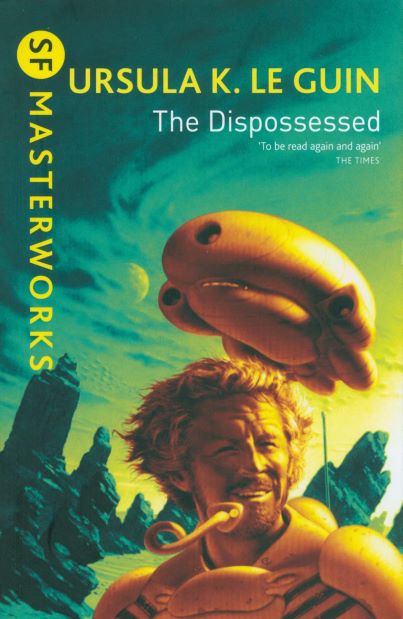
Retro cover art for Le Guin's The Dispossessed, the novel in which the utopian language of Pravic is invented.

Computers still influence the vocabulary, as well as other organisational and distributional processes in society, at least where proper nouns are concerned. Names are assigned by computer at birth, usually following a two syllable pattern: Shevek, Takver, Rulag, Bedap etc.

Founding principles

Pravic is the language of the Anarresti, an anarchist society living on the moon Anarres.**** They live in exhile, having left their Earth, Urras, in order to be able to live according to their ideals. The population on Urras continue to live in a capitalist, consumerist society.

The ideological concepts of Pravic go back to the founder of Anarresti society, Laia Odo.***** Odo was already an influence on how language was used among her comrades before they felt an entirely new language was necessary to convey their ideals. Odo’s ideals are what we would call anarcho-communist as they reject the state, money, property and class. Life is instead organised communally, work is voluntary, and access to the necessities in life is shared freely.

Pravic embodies these ideals in notable ways. As a people who believe property is theft, the way they speak about possessions is entirely different to societies in which private property is the norm. Two of the worst curse words to them are “propertarian” and “profiteer.” The Anarresti don’t assert “this one is mine and that’s yours.” Instead, they say “I use this one and you use that.”

Work and play

The Anarresti lack of possessiveness is not limited to objects but applies to people, too. Even in romantic relationships, although feelings of intense attachment still exist, they ultimately recognise they do not own or have claim on each other.****** Likewise, there is no sense of hierachy in work or civic relationships. Everyone calls each other “Ammar,” a word which could be translated as ‘sibling’ or ‘comrade.’ Work is voluntary, and the same word is used for work and play: “kleggich”. Those with specialist skills might be given assignments in areas where they are needed, but can refuse. Although, such refusal would not come without reputational consequence. The lazy are called “nuchnibi,” a word describing those able to work who refuse to do so. Yet, no-one is denied food or shelter even if they don’t participate or contribute to the rest of society.

The role of language in forming thoughts

Pravic is designed to help form the thoughts of its speakers. As the protagonist Shevek comments, “Nobody’s born an Odonian any more than he’s born civilised!” A child starts out saying “my Mother,” but in time learns to say “our mother” (“mamme” in Pravic). Children are also taught to speak only about matters that interest others; anything else is “egoizing.”

Pravic has four different categories of vocabulary. These seem to correspond to Dante’s four modes of allegory: the literal (physical, technical, verbal), the allegorical, (symbolic, economic), the moral (ethical), and the anagogical (or religious). It comes as a surprise to those Shevek visits on Urras that there is a spiritual aspect to the Pravic language at all, as the Anarresti are atheists. But he chides his hosts for not thinking his people capable of loftier thoughts: “you could not seriously believe that we had no religious capacity? That we could do physics while we were cut off from the profoundest relationship man has with the cosmos?”

The book is full of philosophy, often repeated from Odo’s texts (one of which is even called “Analogy”), but sometimes from Shevek himself, such as “You cannot keep doors open. You will never be free.” This shows the vocabulary is not purely functional, although it may have begun that way. Yet, theatre was always an important part of their society, and, it wasn’t long before they were composing verse too:

“O child Anarchia, infinite promise
infinite carefulness
I listen, listen in the night
by the cradle deep as the night
is it well with the child”

An unregulated language

Unlike other constructed languages (e.g. Esperanto), Pravic is not a regulated language. This is due to the nature of Anneresti society lacking structures of hierarchy. There is a dictionary, probably compiled by a commitee with the help of computers, but no-one is obliged to use it. However, new compound words are possible to get across unfamiliar concepts, as in this example.

The word he used was not ‘wallowing,’ there being no animals on Anarres to make wallows; it was a compound meaning literally ‘coating continually and thickly with excrement.’ The flexibility and precision of Pravic lent itself to the creation of vivid metaphors quite unforeseen by its inventors.”

The Annaresti people are also not averse to using some of the Iotic language spoken on Urras when needed. This is usually in the form of curse words, such as “hell” and “damn,” the meaning of which are now devoid of their religous references. Other words refer to alien concepts such as betting. Shevek explains “It’s an Iotic verb[…]. A game the Urrasti play with probabilities. The one who guesses right gets the other one’s property.”

Despite the seemingly unbridgeable gulf between the anarchist Anarres and capitalist Urras, in the end Shevek is able to find others on Urras who share the same ideals and hopes. He even discovers that across different languages some concepts remain unchanged: “‘We are the children of time,’ Shevek said, in Pravic. The younger man looked at him a moment, and then repeated the words in Iotic: ‘We are the children of time.’”

Uses of Pravic

Perhaps no science fiction book better embodies anarcho-communist ideals than The Dispossessed. Although these principles existed long before it was written, it has helped inspire many to accept and share the same outlook. In 2016, as part of events marking the 500th anniversary of Thomas More’s Utopia, the linguist Martin Edwardes taught around 270 pupils the language concepts of Pravic and applied them to English in the form of “Pravlish.” He found that within a couple days students were able to adapt to speaking without pronouns and possessiveness. This supports the theory that if we change the way we speak about the world, we can change the way we understand and live within it too.*******

Pronominal nouns in the utopian language of Pravic

Footnotes

*Probably helps with breeding.
**Although whether logical consistency itself is an ideal is arguable, as it is possible to be consistently logical in a competely incorrect closed system.
***One wonders about their ability to deceive, which they would still seem to require as they have spies. Perhaps they would rely on ‘normal’ languages at such times, while remaining honest with each other.
****The Anarresti refer to themselves as “Anarchists.” A Urrasti commentator refers to Anarres as practising “non-authoritarian communism” and then being “socialists” and “libertarian,” which meant the same thing as anarcho-communism until liberal capitalists co-opted it in the mid-1970s.
*****The word ‘founder’ isn’t used in The Dispossessed, but those sharing Odo’s ideas were initially called Odonians by outsiders then reappropriated the term for themselves.
******Sex is one of the few acts that takes place in private rooms, although they would not consider it their room, just “the bed I sleep in.” They lack any “proprietary idioms for the sexual act.” Their word for sex translates as ‘copulation;’ “It meant something two people did, not something one person did, or had.”
*******In linguistics, this is expressed in the Sapir-Whorf hypothesis, and is also known as linguistic relativity. Edward Sapir and Benjamin Lee Whorf suggest that the structure and content of a language influences the way its speakers perceive and think about the world.

Look out for:

Part III – Asa’Pili, Láadan

Nathan Taylor-Gray writes as The Peaceful Revolutionary and is a member of the Utopian Book Collective.

Fictional utopian languages: Part I – Utopian, Houyhnhnm

Fictional utopian languages: Thomas More's Utopian alphabet reimagined by Fraser Muggeridge and Jeremy Deller

In this new three-part series, Nathan Taylor-Gray explores fictional utopian languages and whether they reflect the utopian ideals of their speakers.

Fictional utopian languages: Thomas More's Utopian alphabet reimagined by Fraser Muggeridge and Jeremy Deller, with neon pink background and yellow lettering
Thomas More’s Utopian alphabet reimagined by Fraser Muggeridge and Jeremy Deller

Authors often struggle for the right word, damning the limitations of their language to get across the complex emotions and circumstances of life. Few of them imagine that they, like Shakespeare, can will dozens of words into being by introducing them into common parlance. But some do try to add new jargon or slang relative to their story’s characters and setting, especially when the location or people are alien to this earth, or live in some far future period. Dystopias often make a point of noting changes or even reductions in vocabulary, or alterations in the definitions of common words, often dictated from on high by some despot. Writers understand that words have power, and recognise how much one particular word can change the entire tenor of a passage, especially if it is the wrong one.

It is no surprise then that utopias, seeking to depict a better world, reach for new words to express their ideals, and even resort to inventing whole languages that confront the inadequacies (as they perceive them) of their mother tongue. Despite the relatively large vocabulary of English, its novelists have often tried to contrive new pidgin and patois dialects or new pseudo-technical jargon, as well as entirely new languages to address some of the shortcomings of English, or to create a new lingua franca for their earthly version of heaven. Whereas some modern utopians, who see achieving mankind’s ideals as an imperfect and never ending process, have not been attempting to create a perfect language for perfect people in a perfect world, but a common vernacular which seeks to address some of the unjust and marginalising features of the daily lingo we use to describe our relationships to each-other and things.

In fiction, writers who share these views can imagine how people earthly or alien might address the inequalities they believe are inherent in their own native speech, and speculate how people having a different and better way of expressing themselves might address these problems. The ambiguity and inconsistencies of English is another source of consternation among authors who both benefit and are challenged by it, and is another reason for proposing languages with greater clarity or economy in their vocabulary.

In trying to survey the different language systems which have appeared in English utopian fiction I have tried to limit the list to those books in which there is at least an attempt at imagining a better world. In some cases the story begins or ends with the achievement of that lofty goal, but in many – especially more recent books – it is an aspiration which has been partially achieved and is still being fought for. Some authors take the process of creating their language very seriously, going as far as to change the systems of grammar, alphabets and to imagine pronunciation; whereas others address only the areas where their vocabulary differs and has something to say about the society they are describing. I’ll be looking at both cases and some that don’t quite fall in either camp.

Utopia, Thomas More, 1516

A map of the world that does not include Utopia is not worth even glancing at.” 

– Oscar Wilde, “The Soul of Man Under Socialism”, 1891
Colour reproduction of frontispiece to Thomas More's Utopia

Thomas More’s 1516 book, Utopia, was less of a novel and more of a travelogue, with a traveller recounting their visit to the perfect place, without much of a story, but abundant details about how such a society worked. Portraying More’s own ideals (and biases), his imaginary society encompasses many of the features that are still commonly found in utopian literature today.

One distinctive characteristic of this idealised society was the absence of private property, with all land considered common, and meals eaten communally. Workdays were described as much shorter and everyone was involved in the growing of food, healthcare (and even euthanasia) was freely available, and – perhaps in response to his own frustrations as Chancellor in the areas of church and state – in Utopia there was freedom of religion, but no lawyers, and no hereditary hierarchies.

An intriguing suggestion put forth by Jack Weatherford is that More’s writing might have been influenced by accounts of indigenous societies in what is now North America. These societies were characterised by their “harmony and prosperity without the rule of a king”, as well as their “lack of magistrates, forced services, riches, [or] poverty” (Indian Givers, 1988).

More is believed to have encountered Amerigo Vespucci’s accounts, which widely circulated during his time, which described encounters with indigenous tribes exemplifying communal living and a lack of hierarchical structures:

They neither sell nor buy nor barter, but are content with what nature freely gives out of her abundance. They live in perfect liberty, and have neither king nor lord. They observe no laws. They have their habitations in common, as many as six hundred sharing one building.”

Amerigo Vespucci
An illustration of a communal Haudenosaunee Town showing homesteads within an enclosure wall on a green space at the bend of a river
A Communal Haudenosaunee Town (1142 – 1812)

Such narratives could have served as a source of inspiration for More’s portrayal of an egalitarian society in Utopia. However, in other ways More’s Utopia is far removed from modern progressive views, most notably in the presence of slavery in Utopia.

The Utopian language and alphabet

In addition to the social and political aspects of Utopia, More’s work also introduced linguistic innovations. Utopia holds the distinction of being the first utopian work to associate a new language with its ideal island. Originally written in Latin and later translated into English after the author’s death, the book also incorporates a unique vocabulary and alphabet used by the inhabitants of Utopia.

The Utopian alphabet, which appears to have been devised by More’s friend Peter Giles, consisted of 22 letters. It was based on geometric shapes such as circles, squares, and triangles, and remarkably, these letters closely resembled the Roman alphabet of that time.

Utopian alphabet as published alongisde Thomas More's Utopia

Despite the Utopians possessing a distinct language capable of conveying poetic and philosophical ideas, their vocabulary fails to reflect the unique beliefs, perspectives, and practices of their society. With the exception of a few words that have direct Latin equivalents, there is nothing fundamentally distinctive about their language at all.

While the Utopians express lofty precepts and intentions, as evident in the line “Freely I impart my benefits; not unwillingly I accept whatever is better,” their society still maintains hierarchies and a military, as indicated by the Utopian word “boccas” meaning “commander.”

Similarly, despite the absence of private property, they still possess and speak of owning things, including people, as exemplified by the translation of their word “heman mea” meaning “(those which are) mine.” Yet Utopian society maintains a notable absence of ownership within their houses, as “There is nothing within the houses that is private or any man’s own.”

Utopian (Roman Alphabet)Latin TranslationEnglish Translation*
Utopus ha Boccas peu la chama polta chamaan.
Bargol he maglomi baccan ſoma gymnosophaon.
Agrama gymnosophon labarembacha bodamilomin.
Volvala barchin heman la lavolvala dramme pagloni
Utopus me dux ex non insula fecit insulam.
Una ego terrarum omnium absque philosophia
Civitatem philosophicam expressi mortalibus
Libenter impartio mea, non gravatim accipio Meliora
The commander Utopus made me, who was once not an island, into an island. I alone of all nations, without philosophy have portrayed for mortals the philosophical city.
Freely I impart my benefits; not unwillingly I accept whatever is better.
Table 1: Like the Rosetta stone but for fictional utopian languages

*A more poetic English rendition by Ralph Robinson, a 16th-century translator:

My king and conqueror Utopus by name
A prince of much renown and immortal fame
Hath made me an isle that erst no island was
Full fraught with worldly wealth, with pleasure, and solace.
I one of all other without philosophy
Have shaped for man a philosophical city.
As mine I am nothing dangerous to impart,
So better to receive I am ready with all my heart.

However, in English we also continue to use words whose original meaning has passed, and we have repurposed them in new ways, or they remain to describe things and ways of life that are part of our history, but not our modern experience.

While the Utopians’ language showcases linguistic capabilities and the expression of high ideals, it falls short in reflecting the unique aspects of their society. Despite their lofty aspirations, Utopia still exhibits hierarchies, possession of goods (including people), and a lack of privacy within their communal living spaces. These nuances highlight the complexities and contradictions inherent in More’s portrayal of his idealised society.

It would take a couple hundred more years of fiction before an author would propose a language which embodied the ideologies of its society.

Houyhnhnm, Gulliver’s Travels, Jonathan Swift, 1726

Black and white portrait of Jonathan Swift

Jonathan Swift established himself as a renowned satirist long before the release of his famous work, Gulliver’s Travels. Like Thomas More, Swift skillfully dissected the reality around him, employing satire to craft a thought-provoking narrative that highlighted the issues of his day. In doing so, he resorted to exaggeration to disguise his critique of the contemporary world, which was fraught with risks for those who openly criticised it.

Through the adventures of Lemuel Gulliver, Swift used absurd tales as social commentary, exposing the flaws and follies of contemporary society. By presenting Gulliver as a traveller encountering extraordinary civilizations and their bizarre customs, Swift aimed to shed light on the darker aspects of human nature, politics, and society’s structures.

It is on heading home, back to England, that Gulliver finds his utopia. Stranded following a mutiny, he is abandoned on an island seemingly inhabited by savage human-like creatures called Yahoos, the worst of all the beings he had encountered. But shortly afterwards, in contrast to these ignoble savages, he meets the Houyhnhnms, a race of talking horses.

Swift presents the Houyhnhnms as having “a general disposition to all virtues, and have no conceptions or ideas of what is evil in a rational creature; so their grand maxim is, to cultivate reason, and to be wholly governed by it.” They were so logical that they had no “understand the meaning of the word opinion, or how a point could be disputable; because reason taught [them] to affirm or deny only where we are certain.”

His equine hosts are so certain of the rightness and goodness of their conduct that they “have no word in their language to express any thing that is evil, except what they borrow from the deformities, or ill qualities of the Yahoos” (that is the irrational humans).

This does not mean they are not without feelings, emotions and attachments however. Their society seems to be a kind one (at least to those of the same kind as them): “Friendship and benevolence are the two principal virtues among the Houyhnhnms: and these, not confined to particular objects, but universal to the whole race. For a stranger from the remotest part, is equally treated with the nearest neighbour; and wherever he goes, looks upon himself as at home.”

The Houyhnhnm language

The Houyhnhnms communicate through a language which, to Gulliver, resembles neighing, but possesses similarities to High Dutch or German, albeit more graceful and infused with profound meaning. Their vocabulary is small and is not written, they “have no letters, and consequently their knowledge is all traditional.” Yet they are able to use their language can comprehend and express beauty and is beautiful in it’s own way, as Gulliver remarks that, “In poetry they must be allowed to excel all other mortals; wherein the justness of their similes, and the minuteness as well as exactness of their descriptions, are indeed inimitable. Their verses abound very much in both of these; and usually contain either some exalted notions of friendship and benevolence.”

Their society is characterised by unparalleled honesty, to the extent that the concept of lying is entirely foreign to them. They lack a word for lying and must resort to phrases like “to say a thing which is not” to convey the idea. Indeed they have no words for concepts that are completely alien to them such as, “Power, government, war, law, [and] punishment.”

In the novel, there are only a few examples of Houyhnhnm words given, but they express the nature of the society they belong to. For instance, the word “shnuwnh” captures the concept of death, its literal translation being “to retire to his first mother.” Another word, “hnhloayn,” signifies an exhortation, as the Houyhnhnms “have no conception how a rational creature can be compelled, but only advised.” And the last words Gulliver hears as he departs, “Hnuy illa nyha, majah Yahoo,” which carry the meaning of “Take care of thyself, gentle Yahoo.” These examples demonstrate how their Utopian language encapsulates the values of Houyhnhnm society.

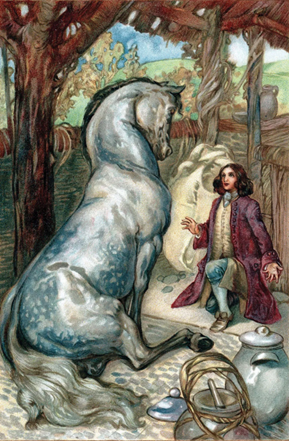
Colour illustration of Gulliver kneeling in front of a horse in a stable abode. They appear in discussion, presumably using the fictional Houyhnhnm utopian language

If what defines a utopian language is that it has unique words that represent its ideals or lacks words that do not represent them, then Houyhnhnm’s vocabulary qualifies as utopian. Such is the power and beauty of their mare tongue that Gulliver continues speaking their language even when in the company of more primitive horses, rather than speak to his fellow humans.

However, not all fictional utopian languages are as suited to poetry, and some do not originate and evolve naturally, but are constructed with a very different set of goals in mind. In the next article we’ll look at societies that invented their languages in pursuit of their ideals, and how that influenced how they spoke, thought and acted in ways different from our own.

Look out for:

Part II – Speedtalk, Pravic

Part III – Asa’Pili, Láadan

Nathan Taylor-Gray writes as The Peaceful Revolutionary and is a member of the Utopian Book Collective.

How to fight the barriers of capitalism with poetry

Detail from artwork by Shiiku Collective as used to advertise their event fighting the barriers of capitalism

Anthropy≠Anthropocene, Shiiku Collective, 9 March 2023, Strange Brew, Bristol.

Carolyn Dougherty reflects on this event, which promised:

expressive spoken word on fighting the barriers of capitalism, interactive visuals co-created by our robot friends, ambient electronic beats with soft rainforest settings, and the voices of those ready to design a world that can be peacefully navigated by all.”

I’m a woman in my 50s, reasonably well read on utopia but perhaps not entirely up to date. I was hoping for fresh, young perspectives on living joyfully in a world we have (at best) badly and unconscionably damaged.

Instead, I heard several young people perform poems and songs expressing their desires in a world where they feel marginalised. The poems weren’t bad; in fact, I thought a couple were quite good. I’m glad I heard them. But, they primarily dealt with the individual’s inner world.

I hope everyone reading this has had the experience of engaging with a piece of art then stepping out into the world astonished at how your own perceptions have been changed by it. That kind of mental and emotional rewiring doesn’t happen when the art is focused on better understanding the artist.

Self-expression as a tool of late-stage capitalism

It is a genuinely powerful act to declare to others that we are proud to accept something about ourselves that our culture has taught us we should be ashamed of. But I dispute that it ‘fights the barriers of capitalism’ and offers a new vision of our world. Rather, it redraws those barriers further out, to enclose more of us.

Self-expression is something we’re taught to value, even revere, and it is valuable. But it also happens to be the ideal lever for late-stage capitalism to break into our interior world, to appropriate what resources still remain out of its control.

In the late twentieth century, the consumption machine encouraged us to express ourselves by buying things. Things that signified allegiance with whatever group we might want others to believe we were affiliated with. By acquiring, wearing or using things coded to belong to a certain group, we hoped to send signals that encouraged other people to assign us the status and group affiliation we desired to project.

What we now optimistically refer to as late-stage capitalism is much more sophisticated, and much less overt. The machine no longer creates and disseminates the rules for obtaining affiliative or distinctive things. Instead, we are more likely to self-define. We choose the signals ourselves, then inform others what these signals mean to us and should mean to them.

A collection, not a collective

It’s still the same mechanism, keeping us focused on who we are and how we identify. We remain preoccupied with both sending the correct signals and ensuring that others receive them in the correct manner. The capitalists win again, as this preoccupation, even obsession, with what we are signalling precludes any possibility that we might actually pay genuine attention to others.

This situation resulted in a grouping of artists that could more rightly be called a collection than a collective. Individual atomised people pinging packets of information to each other as a substitute for actually communicating, engaging, forming bonds, and creating the conditions for effective collective action.

Towards a post-capitalist utopian poetics

Art that focuses on one’s perception of the world paradoxically brings people closer together than art that focuses on one’s perception of oneself. Perceiving the world is something we all do, and an experience we can genuinely share. (I’m afraid not everyone is thinking about you.)

This kind of art is almost the opposite of the scientific method. Science attempts to organise and achieve an objective description of the world. Its goal is for us to have the same, repeatable, predictable experience. And economics, of course, likes to position itself as a science.

The goal of art is to help us have as many different experiences of the world as there are people. Relating to each other through sharing our experience of the world may be the most effective way to create the kinds of shared experience that could lead to collective action, and someday the creation of what could be a utopia.

Carolyn Dougherty is an economic historian and railway engineer currently based in Bristol. Her research and writing addresses the origins of capitalism and the development of the corporation in early nineteenth-century England. She is a member of the Utopian Book Collective.

A Little Woman’s Utopia

A Little Woman's Utopia: illustration by Flora Smith showing the gathering in of the harvest at Fruitlands

Astrid R. Abildgaard is a teacher and recent MA graduate in English and History from the University of Copenhagen in Denmark. In this article, she argues for using utopia not as a blueprint, but as a method for finding productive desires for a more just world, even in the most unexpected places.

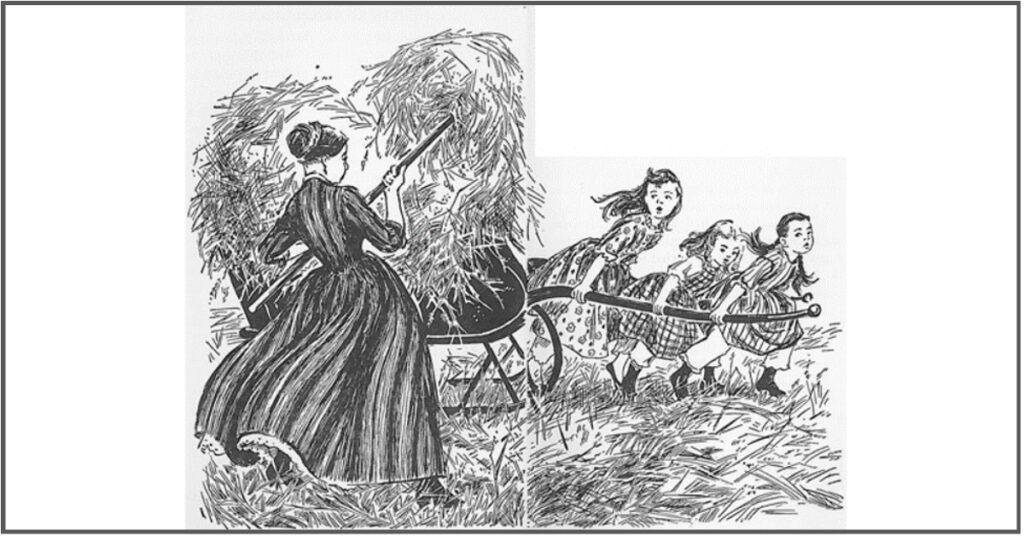
A Little Woman's Utopia: illustration by Flora Smith showing the gathering in of the harvest at Fruitlands
Gathering in the harvest at Fruitlands. Illustration by Flora Smith for The Story of Louisa May Alcott by Joan Howard.

When we think about the concept utopia, we usually imagine an island or a planet full of uncorrupted nature where people (or aliens!) have established a progressive social order. It is a fully physical space, even if it is imaginary. That is the type of utopia described by Thomas More when he first coined the term in 1516 by conflating the Greek eutopia (meaning good place) with outopia (meaning no place). In other words, More’s utopia is an ideal place that does not or cannot exist.

However, as the utopian theorist Ruth Levitas has pointed out in The Concept of Utopia (1990), utopia can also simply be a desire for a better way of living, which can become a catalyst for real change in some place. That type of utopia is one that can spring up in unexpected places – even in the seemingly traditional domestic novel of one of your favourite authors.

Utopian desire in… Little Women?

Ever since Louisa May Alcott wrote Little Women in 1868-69, it has been a staple of children’s literature all over the world. It is a universal yet traditional girls’ story about growing up, as we follow the four March sisters’ trials and tribulations on their way to womanhood and (one might say “of course”) marriage.

The story has also maintained its popularity among adults because of its multiple screen adaptations, most recently in the form of Greta Gerwig’s 2019 box office hit.

Little Women film poster

Gerwig’s adaptation is especially interesting because it recognizes what many readers had already picked up on: that the rebellious sister Jo is really a fictional version of Alcott herself – a fact that Alcott confirmed in her journals. Jo is an aspiring writer, who proudly vows to never marry and let a man stand in the way of her career. Accordingly, the traditional ending – in which Jo marries a much older professor – has confounded readers ever since the novel’s publication.

But Gerwig changes this much contested part of the story by blurring the lines between Jo and Alcott and having Jo bypass marriage to pursue literary success like her author (who, in fact, complained in her letter that her publishers made her marry off Jo “in a very stupid style”). In this way, Gerwig highlights not only the autobiographical connection between Alcott and her protagonist, but also the independence and feminism of both. By acknowledging this autobiographical connection, we can uncover another progressive note in the novel: one of utopian desire.

Alcott’s life at Fruitlands: a fruitless utopia

To do this, we need the context of Alcott’s life and writing. Few people know that as a child in the 1840s, Alcott participated in (or rather: was the victim of) her father’s experimental utopian society called Fruitlands. This community sought to transcend society’s evils like private property, trade, animal labor and self-indulgence through a focus on philosophical self-improvement. However, it lasted only seven months before it was brought to an end by the coming of winter and the men seemingly having forgotten to do the farming necessary to feed the community.

This childhood experience stuck with Alcott, and she wrote about it in her journals from the time as well as later in a less-known satirical short story called “Transcendental Wild Oats” (1873). In this story, Alcott ridicules her father’s unrelenting focus on philosophy and resulting disregard for the practical measures needed to sustain the utopian plan, which all resulted in an overburdening of the women in the community: Alcott herself, her mother and her three sisters.

The women save the community, first, by bringing in the harvest in the absence of the men, who have gone on a philosophical pilgrimage, and then by forcing the family to leave the doomed experiment and taking the practical measures to secure the family a more stable home. Alcott’s message in the satire is clear: lack of appreciation for women’s practical work is what undid Fruitlands, and women’s work for the community is what saved the family from impending dystopia.

Leaving utopia: illustration showing the removal from Fruitlands, January 1844
Removing from Fruitlands Jan. 1844. Houghton Library, Harvard University.

Principles and practicality (and matriarchy)

When read in this context, Little Women displays a similar criticism of impractical utopianism. In the novel, Alcott reiterates Fruitlands’ ideals of self-improvement and self-sacrifice as guiding principles for the March family, but it is the reign of the mother, Mrs. March, that secures their practical implementation and prevents them from getting out of control. In the 11th chapter, “Experiments,” she lets her daughters skirt their chores – as an allegory to Fruitlands – letting them realize the necessity of practical work for the community on their own. Mr. March is notably absent throughout most of the story, and the happy, well-functioning home consists only of a community of women.

Alcott does not, however, let this childhood utopia stand unchallenged for long. Realistically, she depicts that the little women must grow up and eventually marry for money or love or both (or die like the sister Beth). Although Alcott idealizes the community of women throughout the novel, she seemingly does not want to get rid of men altogether; rather, she seeks to redefine their role in the household.

The three sisters that marry (Meg, Jo, and Amy) all take control of their marriages and teach their husbands how to help them with domestic chores and childcare while letting the women have their own agency and independence. Thus, Jo proclaims to her husband that their marriage will be one of equal responsibility and that she is intent on earning money herself. Alcott seems to argue that a happy marriage requires men and women to have equal responsibilities for domestic duties and equal amounts of independence in the family community. If that had been the case at Fruitlands, maybe they would have been fed, and the utopia would have had a chance.

A feminist yet practical utopian desire for gender equality

Alcott makes her desire for an altered relationship between men and women clear at the end of the story, when she depicts a functioning alternative to Fruitlands. The family celebrates Mrs. March’s birthday at Plumfield, the school Jo has established with her husband. Unlike Fruitlands, Plumfield allows for equal influence from the female and male elements (!), and Jo takes on the role of the matriarch of the community. The second half of Little Women, then, does not show a lack of utopian desire, but rather Alcott’s awareness of the limitations for women at the time.

Alcott criticizes her father’s unrealistic attempt at utopia in More’s sense while presenting an alternative in the form of feminist yet practical utopian desire for gender equality – even as she submits to the traditional ending in marriage. Thus, we can reconcile the conflict over the ending of Little Women without changing it to fit the independent feminism Alcott expressed elsewhere.

The example of Little Women reminds us not only of the feminist possibilities (and limitations) of 19th Century women’s fiction; it also shows us how we can use utopia not only as a blueprint for an ideal that is inherently impossible, but as a tool for discovering productive patterns of thought about a more just world, even in the most unexpected places.

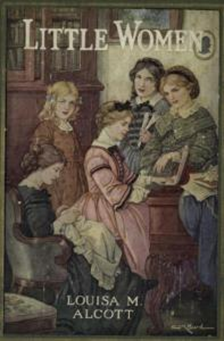
Vintage book cover for the utopia 'Little Women'

Much of this article is based on Abildgaard, A. R. (2022). A New Biographical Interpretation of Louisa May Alcott’s Little Women: A Practicable Feminist Utopia? [Master’s thesis, University of Copenhagen]

Explore other guest posts on the Just Utopias blog here.

The Solvable Body: Dreaming of a Trans Utopia

dreaming of a trans utopia

by Brienne D. Hayes

Brienne D. Hayes is a non-binary writer and queer theorist from San Diego, California. They are currently studying for their PhD in English at the University of Illinois at Urbana-Champaign. Their work can be found at briennehayes.com.

In a world without gender, what would it mean to be trans?

This question may seem absurd, or worse, contradictory to the aspirations of women’s and trans liberation. To understand its importance, let us first invent a world without gender.

Imagine a social utopia that no longer sees people in terms of a gender binary. This is a world that does not print a person’s gender on birth certificates or ask for it on job applications; it is, as posited by neuroscientist Daphna Joel, a world

in which humans are treated according to who they are, and not according to the form of their genitals; in which even the thought of grouping them by their genitals sounds as bizarre as grouping people according to the color of their eyes.”

https://blogs.scientificamerican.com/observations/its-time-for-a-world-without-gender/

It seems reasonable to suggest that any world that fails to meet this ideal could not rightly be called a utopia.

Now, imagine that our utopia is also a technological utopia in which medical science is so sophisticated that any imaginable rearrangement of the human body is possible. Any disease can be cured; any physical attribute can be modified; any element of the body can be altered at the genetic level. The moment a hypothetical transgender person in this world begins to feel discomfort from their primary or secondary sex characteristics, they can have them changed via a simple, accessible procedure; if they regret the changes, they can have them reverted that same day.

Under these ideal conditions, the process of transition has been removed from the transgender experience. Social transition is obviated by the lack of significant gender categories; medical transition is no more substantial than a trip to the dentist. A person realizes that they’re trans and, within a day, they’ve “completed” their transition. In our utopia, then, is there any need for “transgender” to exist as a category of identity at all?

If our invented world seems utopian, imagine now that we replace the idea of gender with the idea of race or disability. In these alternate “utopias,” we eliminate racism by allowing everyone to become white, or we eliminate discrimination against the Deaf by allowing everyone to become hearing. In the world of our thought experiment, we have not accomplished trans liberation; we have only succeeded in making everyone cis. These solutions do not eliminate the underlaying structures of oppression; they simply “innovate” the oppressed groups out of existence.

I have been unable to shake this thought experiment since coming out as transgender and, shortly thereafter, reading Samuel R. Delany’s 1976 novel Trouble on Triton, one of only a few pre-21st century science fiction novels to explore trans identity (I think that it is important to note that Delany is a cis man, but is also a black, gay, disabled man who has always centered ideas of identity and difference in his work).

The world of our thought experiment is inspired by the world of Triton, in which Bron Hellstrom, a transwoman, undergoes a near-instantaneous gender confirmation surgery, complete with whole-body feminization surgery and the replacement of XY chromosomes with XX chromosomes, in the penultimate chapter. Bron’s social transition goes as smoothly as her physical transition, as the culture of Triton does not discriminate on the basis of gender. But transition does not free Bron from the ennui and misery that permeate her pre-transition life, as the misogyny that Bron learned in her childhood on planets beyond Triton has so permeated her identity that she became, in the words of her friend, “a woman made for a man.”

It’s tempting to think that we can resolve Bron’s dilemma by eliminating the extraplanetary misogyny, alien to Triton, that is the basis of Bron’s struggles post-transition. In doing so, though, we exclude from our hypothetical utopia any person who has ever experienced misogyny. Generalizing this beyond gender, we see that this utopia could not include any person who has ever been the subject of any structural violence of any kind—our utopia is, in effect, a world without difference.

I am sure that, to some, any utopia would by necessity be a homogenous world without identity or difference. How do we reach that world from our own, though, without erasing all who are different, through assimilation or through elimination?

Samuel Delany Triton
By Source, Fair use, https://en.wikipedia.org/w/index.php?curid=14992912

I believe that such a feat is, by its nature, impossible. We live in a world built on difference; our utopias, I think, must be built on difference as well. When I ask, “in a world without gender, what would it mean to be trans?” I am really asking, “in a world that does not mistreat those who are different, what does it mean to be different?”

Here, we risk equating identity and suffering. There is a tendency within the transgender community to amplify trans suffering while rendering trans joy invisible, as we are suffering, and we hope that those in power might see our suffering and be moved to address it. While suffering is important to any marginalized identity, to equate being trans with suffering is to cast trans-ness as a problem that needs to be solved—and when we imagine utopias without gender, it is all too easy to “solve” the suffering of transgender people by imagining that we no longer exist.

The subtitle of Delany’s Trouble on Triton is An Ambiguous Heterotopia, where, I believe, heterotopia refers both to a world that is different from ours and to a world in which difference is essential. Delany does not posit Triton as a utopia, and we are left to wonder: can any heterotopia also be a utopia, or do all utopias, by their nature, exclude the possibility of difference?

If we define utopia as a world without suffering, then perhaps the only way to achieve a utopia would be through the elimination of difference. Instead, let us reconceptualize the utopia as the heterotopia, as a world in which the agonies and splendors of difference are allowed to flourish. Let us assert the right to difference, to individuality, to belonging and un-belonging alike. Let us imagine futures in which we seek not to erase difference, but to center it, so that we might benefit from its infinite potentialities.

In a world without gender, being trans means inhabiting, transforming, and exploding gender, not erasing it. It means finding the space for gender in all of its manifestations, not insisting on a single standard of androgyny. It means insisting that we will not be erased.

This post is part of the Guest Posts series. If you would like to contribute, get in touch.

Car free cities are the antidote to environmental injustice

by Rob Bryher.

Rob Bryher is the founder of Bristol Utopian Book Collective and campaigner for the climate action charity Possible. In this article he argues car free cities could bring about social and environmental justice, and shares his three favourite utopian reads. Rob was an elected councillor for the Green Party in Bristol (UK) and has an MSc in Urban Planning.

Car free cities as socially just utopias

The car free movement (and its accompanying literature) focuses on one of the 20th century’s most-feted – and now increasingly most-maligned – innovations: the internal combustion engine car. Globally, vehicle registrations have risen from 126 million in 1960 to approximately 1.4 billion today.1

The car free case is not just centred around the car’s increasingly negative impact on air pollution and climate change, but also on its inefficiency in moving large numbers of people around cities, its effect on physical health and its tendency to take over public roads, pavements and footways when not being used. This is not to mention the 1.3 million people killed globally each year by motor vehicle collision incidents.2

What do car free cities look like?

There are no known examples of the entire administrative area of a city being completely free of cars. Even Venice, long-cited as an example of a car free city, is not entirely car free.

Large car park in the supposedly car free city of Venice
Large car park in “car free” Venice

What we’re really talking about here is large areas of cities being free from traffic passing through as the predominant use of mobility space and the reallocation of road space (e.g. parking spaces) to other uses.

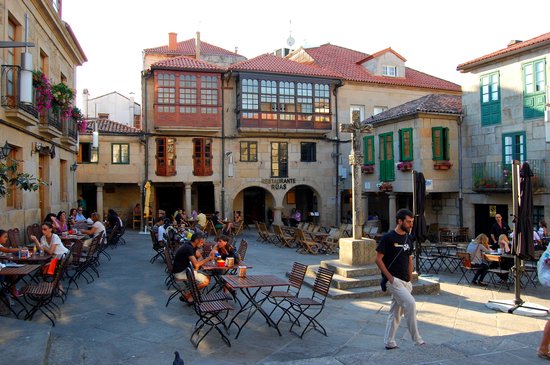
One of the best examples of this is Pontevedra, Spain which began pedestrianising its city centre in 1999 so that today motor vehicle access is only possible for residents and services. Car parks on the outskirts of the city centre allow for access to visitors by car and for residents to keep a vehicle. This measure has reduced carbon emissions by 65% in the central area.3 The centre is not dominated by trams, trains or buses either, but a public transport hub exists to the south of the city centre.

While this might be OK for a smaller city (the population is 82,000), a medium or larger city would need to include transport interchanges within the main central area and carefully plan how these modes interact with walking and cycling infrastructure to create a sustainable and user-friendly mobility system. These spatial changes may concretely improve emissions in one area, but do they create the conditions for those marginalised by various factors to access our cities?

Defining “car free” inclusively of disabled bodies

For a socially aware and just reading of the term “car free”, we must acknowledge that the term doesn’t mean that cities (or any place it applies – many existing car-free places are islands) have no motorised personal transport options at all. The charity I work for, Possible, puts it like this:

From the outset, let’s be clear – a “car free city” is a city which is free of the dangers, pollution, and emissions caused by mass private car ownership. It’s not a city with no cars at all. We recognise there are many people, including disabled people, who cannot get around without a car, and our campaign to reduce the number of cars in cities will make their lives easier too.”

Possible

Thus, the intersection between disability rights and car free campaigning is central to the entire discussion. In my experience, disabled people see the problems with the over-dominance of cars over the urban landscape. Impassible pavements/footways, inability to access parking close by to facilities due to general parking being the norm and road danger are all central concerns that need addressing.

The antidote to environmental injustice

The climate emergency calls us to consider the global effect of overuse of internal combustion engine vehicles, but in policy terms it is often far simpler to make a case for policy interventions on the basis of the effects of air pollution. The relationship between communities with low car ownership, high levels of air pollution and high levels of deprivation is closely connected.

A study by the Air Quality Management Resource Centre at UWE Bristol found that “households in the poorest areas emit the least NOx (nitrogen dioxide) and PM (particulate matter), whilst the least poor areas emitted the highest, per km, vehicle emissions per household through having higher vehicle ownership, owning more diesel vehicles and driving further.” This may seem like common sense, but the study also states that “areas with the highest proportions of under-fives and young adults, and poorer households, have the highest concentrations of traffic-related pollution.” Poorer people are paying in health (and premature mortality) for a problem they are largely not causing.

Poorer people are paying in health (and premature mortality) for a problem they are largely not causing.

The socially just car free utopian city

As already discussed (in the case of Pontevedra), interventions to create a car free paradigm shift tend to focus on the pedestrianisation of city centres. In policy terms, this change represents low-hanging fruit as, predominantly, city centres do not have sufficient space to accommodate residential parking anyway.

More crucially, the effects of vehicle-sourced air pollution are most prevalent in residential areas that lie just outside city centres. This is where low-traffic neighbourhoods (sometimes called livable neighbourhoods) can be an effective policy tool. LTNs are a way to prevent through-traffic from using residential streets. Counterintuitively, this does not mean simply passing the problem on. The evidence shows that removal of road space for motorised vehicles tends to lead to traffic evaporation or disappearance, rather than transference to surrounding streets.

Therefore, there is definitely a case to be made that residential areas with low car ownership, high air pollution and high income deprivation should be the first to be consulted on when LTNs are proposed in cities. This should be the first focus for climate and transport campaigners who want to create socially just car free utopian cities.

My three favourite utopian books

Le Guin conjures a stark and compelling portrait of an anarchist desert planet with a free-but-planned economy based around voluntary service.

I loved the way this very matter-of-factly proposed its political governance arrangements as a sort of streamlined “community vs capital” discussion.

The world has moved on from some of the cultural mores of this 1970s classic, but I still find it an interesting read for re-examining our contemporary understandings of what makes up a utopian city.

Notes

1 Stacy C. Davis; Susan E. Williams & Robert G. Boundy (August 2018). “Transportation Energy Data Book: Edition 36.2” (PDF). Oak Ridge National Laboratory. https://tedb.ornl.gov/wp-content/uploads/2021/02/TEDB_Ed_39.pdf#page=76

2https://www.cdc.gov/injury/features/global-road-safety/index.html

3 https://www.theguardian.com/cities/2018/sep/18/paradise-life-spanish-city-banned-cars-pontevedra