Utopia on the radio: climate justice and utopia-related podcasts.

For those times when reading is impractical – chopping vegetables, folding laundry – you can still absorb utopian content through your ears. Have I made that sound appealing? What I mean to say is you can listen to inspiring and funny podcasts about climate justice and the possibility of a better world. Such as these.

Free-Thought Podcast by Shuddhashar

I came to this podcast for an interview with Dr Heather Alberro, an academic working in the area of social and political sciences. Alberro has an interest in green utopianism and the interview discusses the challenges of ‘creating a world that is sustainable and environmentally just’.

Alberro explains with such ease how the good health of economies and the environment are intertwined it makes you wonder how anyone thinks we should have to choose one over the other.

The whole idea behind environmental justice is that these things are very closely intertwined, you can’t have ecological wellbeing and sustainability without guaranteeing social wellbeing, breaking down hierarchies around class, race, gender, access to resources.

Dr Heather Alberro

After the interview with Alberro, I rolled straight into the next episode – an interview with anthropology scholar Avery Delany about decolonisation. I am very intrigued by this podcast series.

Jon Richardson & The Futurenauts

Comedian Jon Richardson, of BBC 6 Music Sunday morning radio show fame (yeah he’s done some telly and stand up since), hosts this podcast with futurists/Futurenauts Ed Gillespie and Mark Stevenson. The structure of each episode on subjects such as food, work, energy and nature is based around two questions. Firstly, how fucked are we? (Invariably, royally.) Secondly, how do we unfuck ourselves?

In series two they consciously invited guests in to break up their all-bloke line up a little. Highlights for me were Kate Raworth, author of Doughnut Economics, on the Future of Economics and an episode on the Future of Shit (yes, human faeces) with Rose George. I think about that one every time I flush the toilet, and every time I don’t.

I have to say though I think I preferred the first series. Three people saying stuff I agree with about topics that worry me and making it funny, with some practical ideas too. I found it reassuring and hopeful.

Mothers of Invention

Climate change is a manmade problem with a feminist solution. Boom! Each episode of this podcast features women around the world who are taking action in their communities to change the world for the better. The show invites them to tell their own stories of inventing sustainable solutions to the climate problems they face.

Learning about these womens’ fights for climate justice is inspiring and inspires hope. This is another hugely uplifting podcast about terrifying issues.

The hosts are former Irish president Mary Robinson and comedian Maeve Higgins, joined by their producer Thimali Kodikara in series three.

ASLE EcoCast

This is the literary entrant in my list. The ASLE EcoCast is the podcast of the Assocation for the Study of Literature and Environment, an academic society. Each episode the hosts are joined by a different academic working in the areas of literature and the environment.

I have two favourite features of the show. Firstly, host Jemma Deer exploring the etymology of an apposite word like ‘forest’, ‘scene’ or ‘book’ in a poetic kind of way at the start of each episode. Secondly, I like hearing about the guest’s route into academia and whatever specific area of interest they are currently working on. Hearing their way in gives me a way into their work. It also makes me wonder what story I might tell in the future…

Listening to climate justice and utopia podcasts
That’s it folks, happy listening! Let me know your recommendations in the comments or contact me here.

North America: a failing colonialist utopia?

Pandemic. Wild fires. Climate crisis. Biodiversity crisis. Rise of the far right. Sometimes, it seems like things aren’t going so well.

I heard an Indigenous viewpoint on the multiple crises facing North America (and the world) from scholar Dr Kim TallBear at the ASLE (Association for the Study of Literature and Environment) Nearly Carbon Neutral virtual conference in July 2020. It was enlightening, perspective-shifting stuff. I want to share with you some of the thoughts that have stayed with me ever since.

What TallBear believes she is witnessing in the US is “the implosion of the western colonial project”. In other words, the current crises can be seen as catastrophic consequences of settler-colonialism. Consequences of disrespecting and destroying the land and its peoples: humans, plants, animals, minerals and water. Consequences of arriving on an already occupied continent and perceiving it as an empty page on which one is entitled to design a new world.

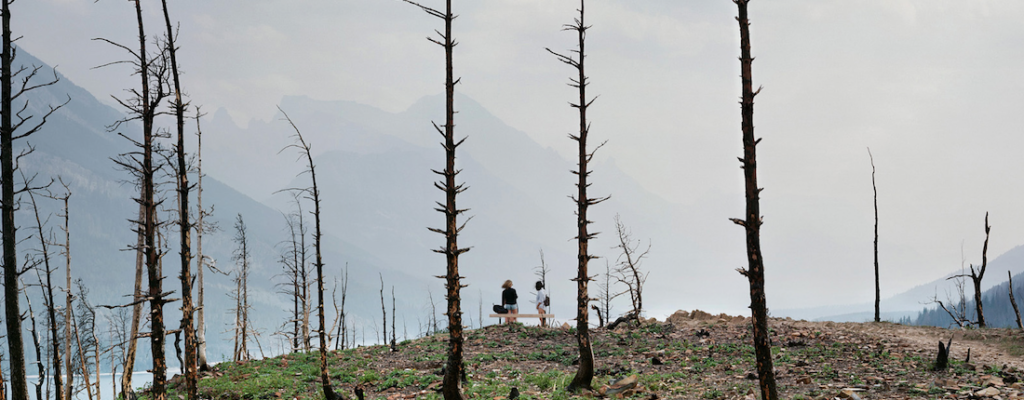
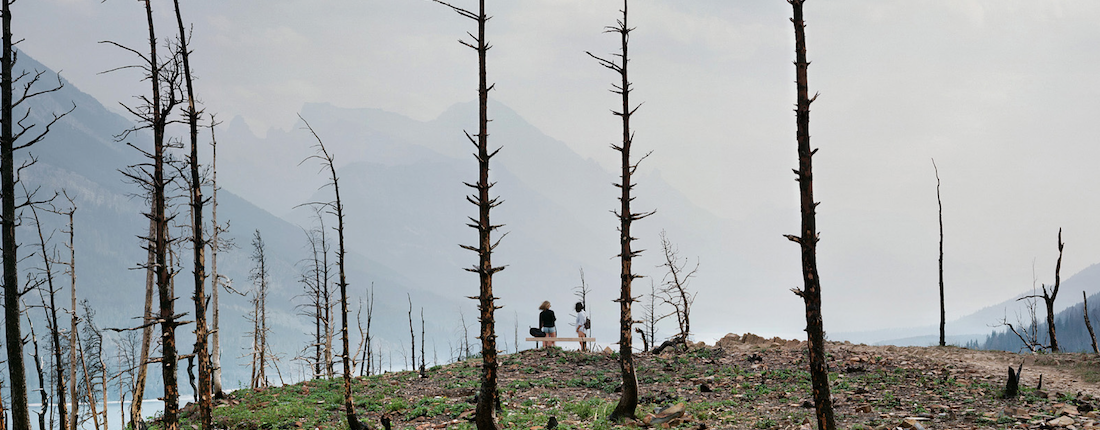
Rutkauskas – Burned Hill. Source: http://ehc.english.ucsb.edu/?page_id=20002

Colonialism as a utopian project

Before hearing TallBear’s talk, I hadn’t recognised the utopian impulse within colonialism. But it doesn’t take much examination of the concept of “the western colonial project” to recognise it as a utopian project.

There is a dark side to utopia, and that is when one person or group’s vision of an ideal world is enforced upon others. The history of Europe in the 20th Century gives us two clear examples: Stalinism and Nazism. Through these I already understood there can be a fine line between utopianism and authoritarianism. Now I see another terrible example of utopian world-building in the violence of settler-colonialism.

For Indigenous People across the American continents, mortality rates due to disease, starvation, forced assimilation and war resulted in estimated 90% mortality rates. For my own people, the Dakota, we now have seven and eight generations of Dakota people who have lived in a Dakota post-apocalyptic world. Indigenous Peoples are still mourning, still living in scarcity, still rebuilding from the quieting of our ancestors’ worlds.

Dr Kim Tallbear

When utopian thinking can lead to genocide and apocalypse, is it only right to give up on utopia?

Utopia as a decolonial project

The realisation that colonialism is a utopian project led me to wonder whether utopia is always a colonial project. I think there are certainly many examples of utopias with colonial logic at their heart whether they realise it or not – many most probably not. These include green utopias with benevolent creators, who nevertheless want to impose their idea of the optimum way to live upon whole cities, countries, continents, planets.

However, there is more than one way to be utopian. There is the being an architect of a superior world way, which is the potentially authoritarian, colonialist, troubling way. Then there is another way where you simply refuse to accept the conventional limits of what is possible and dare to imagine otherwise. This second way is, I think, too important to give up. In fact, it could be crucial to decolonisation.

In her address, TallBear explained

As a Dakota, who has always struggled in a world where an anti-settler state ethic seemed unspeakable, privileging the Dakota Oyate – the people and worldview – was deemed impossible throughout much of my life. Unrealistic, mythological.

Dr Kim TallBear

It is this kind of deemed impossibility that can be undermined by the second type of utopian thinking. Being utopian in this way means being alive to the possibility of things being different from how they currently are. Knowing that things could be different then puts you in a position to ask critical questions. Is this, which my society tells me is impossible, really impossible, or could it be possible after all? Is that a real boundary, or will my hand go right through it? Can I think differently to how I thought I had to think?

Radical hope

TallBear senses a “radical hope” within the multitude of crises facing the US and Canada.

I’m not celebrating what’s happening to the planet and to our non-human relatives and some of the most vulnerable humans […] but I think there are opportunities for us to think about the demise of certain intellectual systems that are incredibly violent as we are reckoning with earthly systems agitations against anthropogenic change.

Dr Kim TallBear

I agree there is hope where the demise of one worldview allows room for others, and I see the thrilling potential for decolonised utopias to rush into the intellectual space left behind.

Dr Kim TallBear is enrolled Sisseton-Wahpeton Oyate and descended from the Cheyenne & Arapaho Tribes of Oklahoma. She is Associate Professor, Faculty of Native Studies, University of Alberta. You can see her address in full below.

INVASION documentary

Elsewhere at the same conference, I attended an online watch party of the short film INVASION. This documentary follows members of the Wet’suwet’en Nation as they protest against the Canadian government permitting oil companies to lay pipelines across their land. The land in question has never been ceded to Canadian settlers. This film brought it home to me that colonialism is not an historical event or a time period that has passed. Colonial logic still prevails and this is why we need utopia. We need better ways of thinking, or new “intellectual systems” to use TallBear’s term.

The Way to Utopia in an Environmental Crisis

My own contribution to the ASLE conference was a paper on Ursula K. Le Guin’s Always Coming Home. The paper, which you can view below, looks at how in Always Coming Home Le Guin manipulates the genre of utopia in order that the form of her book can be true to its feminist, ecological content. I also wrote an article on this subject, which you can read here.