In The Seep by Chana Porter, utopia has been brought about by means of an alien invasion. What follows in this novella is a loving pastiche of contemporary utopian tropes. The emotional processing, sensitivity to ecological connections, and community-mindedness. Its diversity in terms of race, gender and sexuality. The abolition of money and the police. And the complete mitigation of human-induced climate change.
Porter’s novella has a wry sense of humour. There’s a cafe called ‘My Attitude is Gratitude’. The alien communicates with our protagonist through an electronic pamphlet. The words magically change depending on her predicament, offering wisdom whenever she might go astray.
So, you’re thinking of going on a vengeful quest! We applaud your passion and your conviction, and we recognize that you have a lot to be hurt and angry about. […] But consider your end goal here. Hurting someone who’s hurt you will only create more hurt. How can we help you feel better in a more productive fashion?”
The Seep
The Seep – a fun guy to be around?
The alien in question, known as The Seep, is a fungal kind of presence. And I don’t believe I’m saying that just because I read The Seep immediately after reading Merlin Sheldrake’s Entangled Life. (The subtitle of Sheldrake’s book on fungi is ‘How Fungi Make Our Worlds, Change Our Minds and Shape Our Futures’.) The Seep is in the air and the water, from which it enters the body and alters the mind of the human it arrives in. They experience enlightenment, a sense of being part of a great whole, and the feeling that everything is going to be OK.
The Seep also does more wacky stuff, like allowing transformations such as growing antlers or becoming a newborn baby to start out all over again. It can also heal both people and the Earth. It can cure cancer by persuading cancer cells ‘to die gracefully, to let go and become something new’.
So, your planet is under the control of a benevolent utopian overlord!
The Seep is a benevolent presence that makes you wonder what it’s getting out of this arrangement. What’s the grand plan? Is The Seep using humans in pursuit of some greater goal? Do humans still have any free will?
Humans are almost always under the influence of The Seep. When ‘seeped’, they make decisions that benefit themselves, society and the planet as a whole. While the outcome is in their best interests, their minds, and hence their actions, are ultimately controlled by The Seep.
As such, The Seep is a typical utopian overlord. To create and then enforce a utopia, there has to be some kind of coercive control. This is a common feature, or problem, with utopias and The Seep offers a new way of approaching it. The Seep makes everyone of one mind, and it’s very helpful and everyone’s happy… But… Are they free? Is this utopia? Is utopia ever utopian at all?
If you are in the vicinity of Bristol, UK and you would like to discuss this book in person, come along to our next Utopian Book Collective meeting on 4 September.
In this new three-part series, Nathan Taylor-Gray explores fictional utopian languages and whether they reflect the utopian ideals of their speakers.
Thomas More’s Utopian alphabet reimagined by Fraser Muggeridge and Jeremy Deller
Authors often struggle for the right word, damning the limitations of their language to get across the complex emotions and circumstances of life. Few of them imagine that they, like Shakespeare, can will dozens of words into being by introducing them into common parlance. But some do try to add new jargon or slang relative to their story’s characters and setting, especially when the location or people are alien to this earth, or live in some far future period. Dystopias often make a point of noting changes or even reductions in vocabulary, or alterations in the definitions of common words, often dictated from on high by some despot. Writers understand that words have power, and recognise how much one particular word can change the entire tenor of a passage, especially if it is the wrong one.
It is no surprise then that utopias, seeking to depict a better world, reach for new words to express their ideals, and even resort to inventing whole languages that confront the inadequacies (as they perceive them) of their mother tongue. Despite the relatively large vocabulary of English, its novelists have often tried to contrive new pidgin and patois dialects or new pseudo-technical jargon, as well as entirely new languages to address some of the shortcomings of English, or to create a new lingua franca for their earthly version of heaven. Whereas some modern utopians, who see achieving mankind’s ideals as an imperfect and never ending process, have not been attempting to create a perfect language for perfect people in a perfect world, but a common vernacular which seeks to address some of the unjust and marginalising features of the daily lingo we use to describe our relationships to each-other and things.
In fiction, writers who share these views can imagine how people earthly or alien might address the inequalities they believe are inherent in their own native speech, and speculate how people having a different and better way of expressing themselves might address these problems. The ambiguity and inconsistencies of English is another source of consternation among authors who both benefit and are challenged by it, and is another reason for proposing languages with greater clarity or economy in their vocabulary.
In trying to survey the different language systems which have appeared in English utopian fiction I have tried to limit the list to those books in which there is at least an attempt at imagining a better world. In some cases the story begins or ends with the achievement of that lofty goal, but in many – especially more recent books – it is an aspiration which has been partially achieved and is still being fought for. Some authors take the process of creating their language very seriously, going as far as to change the systems of grammar, alphabets and to imagine pronunciation; whereas others address only the areas where their vocabulary differs and has something to say about the society they are describing. I’ll be looking at both cases and some that don’t quite fall in either camp.
Utopia, Thomas More, 1516
A map of the world that does not include Utopia is not worth even glancing at.”
– Oscar Wilde, “The Soul of Man Under Socialism”, 1891
Thomas More’s 1516 book, Utopia, was less of a novel and more of a travelogue, with a traveller recounting their visit to the perfect place, without much of a story, but abundant details about how such a society worked. Portraying More’s own ideals (and biases), his imaginary society encompasses many of the features that are still commonly found in utopian literature today.
One distinctive characteristic of this idealised society was the absence of private property, with all land considered common, and meals eaten communally. Workdays were described as much shorter and everyone was involved in the growing of food, healthcare (and even euthanasia) was freely available, and – perhaps in response to his own frustrations as Chancellor in the areas of church and state – in Utopia there was freedom of religion, but no lawyers, and no hereditary hierarchies.
An intriguing suggestion put forth by Jack Weatherford is that More’s writing might have been influenced by accounts of indigenous societies in what is now North America. These societies were characterised by their “harmony and prosperity without the rule of a king”, as well as their “lack of magistrates, forced services, riches, [or] poverty” (Indian Givers, 1988).
More is believed to have encountered Amerigo Vespucci’s accounts, which widely circulated during his time, which described encounters with indigenous tribes exemplifying communal living and a lack of hierarchical structures:
They neither sell nor buy nor barter, but are content with what nature freely gives out of her abundance. They live in perfect liberty, and have neither king nor lord. They observe no laws. They have their habitations in common, as many as six hundred sharing one building.”
Amerigo Vespucci
A Communal Haudenosaunee Town (1142 – 1812)
Such narratives could have served as a source of inspiration for More’s portrayal of an egalitarian society in Utopia. However, in other ways More’s Utopia is far removed from modern progressive views, most notably in the presence of slavery in Utopia.
The Utopian language and alphabet
In addition to the social and political aspects of Utopia, More’s work also introduced linguistic innovations. Utopia holds the distinction of being the first utopian work to associate a new language with its ideal island. Originally written in Latin and later translated into English after the author’s death, the book also incorporates a unique vocabulary and alphabet used by the inhabitants of Utopia.
The Utopian alphabet, which appears to have been devised by More’s friend Peter Giles, consisted of 22 letters. It was based on geometric shapes such as circles, squares, and triangles, and remarkably, these letters closely resembled the Roman alphabet of that time.
Despite the Utopians possessing a distinct language capable of conveying poetic and philosophical ideas, their vocabulary fails to reflect the unique beliefs, perspectives, and practices of their society. With the exception of a few words that have direct Latin equivalents, there is nothing fundamentally distinctive about their language at all.
While the Utopians express lofty precepts and intentions, as evident in the line “Freely I impart my benefits; not unwillingly I accept whatever is better,” their society still maintains hierarchies and a military, as indicated by the Utopian word “boccas” meaning “commander.”
Similarly, despite the absence of private property, they still possess and speak of owning things, including people, as exemplified by the translation of their word “heman mea” meaning “(those which are) mine.” Yet Utopian society maintains a notable absence of ownership within their houses, as “There is nothing within the houses that is private or any man’s own.”
Utopian (Roman Alphabet)
Latin Translation
English Translation*
Utopus ha Boccas peu la chama polta chamaan. Bargol he maglomi baccan ſoma gymnosophaon. Agrama gymnosophon labarembacha bodamilomin. Volvala barchin heman la lavolvala dramme pagloni
Utopus me dux ex non insula fecit insulam. Una ego terrarum omnium absque philosophia Civitatem philosophicam expressi mortalibus Libenter impartio mea, non gravatim accipio Meliora
The commander Utopus made me, who was once not an island, into an island. I alone of all nations, without philosophy have portrayed for mortals the philosophical city. Freely I impart my benefits; not unwillingly I accept whatever is better.
Table 1: Like the Rosetta stone but for fictional utopian languages
*A more poetic English rendition by Ralph Robinson, a 16th-century translator:
My king and conqueror Utopus by name
A prince of much renown and immortal fame
Hath made me an isle that erst no island was
Full fraught with worldly wealth, with pleasure, and solace.
I one of all other without philosophy
Have shaped for man a philosophical city.
As mine I am nothing dangerous to impart,
So better to receive I am ready with all my heart.
However, in English we also continue to use words whose original meaning has passed, and we have repurposed them in new ways, or they remain to describe things and ways of life that are part of our history, but not our modern experience.
While the Utopians’ language showcases linguistic capabilities and the expression of high ideals, it falls short in reflecting the unique aspects of their society. Despite their lofty aspirations, Utopia still exhibits hierarchies, possession of goods (including people), and a lack of privacy within their communal living spaces. These nuances highlight the complexities and contradictions inherent in More’s portrayal of his idealised society.
It would take a couple hundred more years of fiction before an author would propose a language which embodied the ideologies of its society.
Houyhnhnm, Gulliver’s Travels, Jonathan Swift, 1726
Jonathan Swift established himself as a renowned satirist long before the release of his famous work, Gulliver’s Travels. Like Thomas More, Swift skillfully dissected the reality around him, employing satire to craft a thought-provoking narrative that highlighted the issues of his day. In doing so, he resorted to exaggeration to disguise his critique of the contemporary world, which was fraught with risks for those who openly criticised it.
Through the adventures of Lemuel Gulliver, Swift used absurd tales as social commentary, exposing the flaws and follies of contemporary society. By presenting Gulliver as a traveller encountering extraordinary civilizations and their bizarre customs, Swift aimed to shed light on the darker aspects of human nature, politics, and society’s structures.
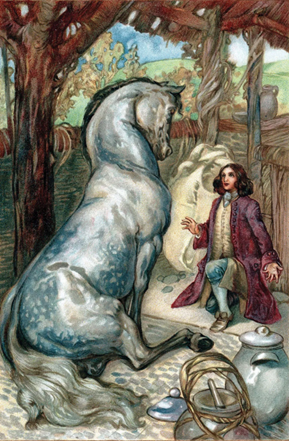
It is on heading home, back to England, that Gulliver finds his utopia. Stranded following a mutiny, he is abandoned on an island seemingly inhabited by savage human-like creatures called Yahoos, the worst of all the beings he had encountered. But shortly afterwards, in contrast to these ignoble savages, he meets the Houyhnhnms, a race of talking horses.
Swift presents the Houyhnhnms as having “a general disposition to all virtues, and have no conceptions or ideas of what is evil in a rational creature; so their grand maxim is, to cultivate reason, and to be wholly governed by it.” They were so logical that they had no “understand the meaning of the word opinion, or how a point could be disputable; because reason taught [them] to affirm or deny only where we are certain.”
His equine hosts are so certain of the rightness and goodness of their conduct that they “have no word in their language to express any thing that is evil, except what they borrow from the deformities, or ill qualities of the Yahoos” (that is the irrational humans).
This does not mean they are not without feelings, emotions and attachments however. Their society seems to be a kind one (at least to those of the same kind as them): “Friendship and benevolence are the two principal virtues among the Houyhnhnms: and these, not confined to particular objects, but universal to the whole race. For a stranger from the remotest part, is equally treated with the nearest neighbour; and wherever he goes, looks upon himself as at home.”
The Houyhnhnm language
The Houyhnhnms communicate through a language which, to Gulliver, resembles neighing, but possesses similarities to High Dutch or German, albeit more graceful and infused with profound meaning. Their vocabulary is small and is not written, they “have no letters, and consequently their knowledge is all traditional.” Yet they are able to use their language can comprehend and express beauty and is beautiful in it’s own way, as Gulliver remarks that, “In poetry they must be allowed to excel all other mortals; wherein the justness of their similes, and the minuteness as well as exactness of their descriptions, are indeed inimitable. Their verses abound very much in both of these; and usually contain either some exalted notions of friendship and benevolence.”
Their society is characterised by unparalleled honesty, to the extent that the concept of lying is entirely foreign to them. They lack a word for lying and must resort to phrases like “to say a thing which is not” to convey the idea. Indeed they have no words for concepts that are completely alien to them such as, “Power, government, war, law, [and] punishment.”
In the novel, there are only a few examples of Houyhnhnm words given, but they express the nature of the society they belong to. For instance, the word “shnuwnh” captures the concept of death, its literal translation being “to retire to his first mother.” Another word, “hnhloayn,” signifies an exhortation, as the Houyhnhnms “have no conception how a rational creature can be compelled, but only advised.” And the last words Gulliver hears as he departs, “Hnuy illa nyha, majah Yahoo,” which carry the meaning of “Take care of thyself, gentle Yahoo.” These examples demonstrate how their Utopian language encapsulates the values of Houyhnhnm society.
If what defines a utopian language is that it has unique words that represent its ideals or lacks words that do not represent them, then Houyhnhnm’s vocabulary qualifies as utopian. Such is the power and beauty of their mare tongue that Gulliver continues speaking their language even when in the company of more primitive horses, rather than speak to his fellow humans.
However, not all fictional utopian languages are as suited to poetry, and some do not originate and evolve naturally, but are constructed with a very different set of goals in mind. In the next article we’ll look at societies that invented their languages in pursuit of their ideals, and how that influenced how they spoke, thought and acted in ways different from our own.
So I had to abbreviate the title for this one, it’s on the long side. To give it its full due, June’s book of the month is ‘Everything for Everyone: An Oral History of the New York Commune 2052-2072’ by M. E. O’Brien and Eman Abdelhadi.
Nathan, a member of the Utopian Book Collective, has recommended this one. I think there will be much to discover and talk about through reading this book.
First interesting point – two authors. Utopias are often the singular vision of a sole author. Is a co-authored utopia better for being collective, or is the vision compromised?
Second, the authors themselves. They aren’t fiction writers. O’Brien is a theorist and has worked on real life oral history projects. Abdelhadi is an academic who also creates performance art and writes poetry. They are both activists. So how does a utopia written by activists differ from a utopia by, say, a sci-fi author?
Third, the form of the book. It’s written as a series of interviews with the (fictional) revolutionaries who made the (fictional) commune. Are the various voices believable? Is it a convincing way to write a utopia, and is it enjoyable to read?
And then, of course, there’s the content of the utopia itself. Is the New York Commune an ideal world and could it really come about?
If you’re in Bristol, UK, come along to book group and join in the discussion! Enjoy a drink from the bar and maybe even, like Carolyn at last month’s meeting, you will find utopia at the bottom of your glass.
Are you further afield? That’s what the comments section is for. Let us know your thoughts on this month’s book below.
The thing that took me farthest out of my comfort zone in 2022 was attending the Utopian Studies Society conference. I thought it would be nice to have a few days away to discuss all things utopian but I was wrong. I stretched my elastic too far just to get there. It was my first time travelling on my own and travelling much at all since the pandemic and having a child (both things that have tied me to home over the past few years). Having to then leave my room and attend events was so hard. This is despite my room (in student halls) being unbearably hot and depressing.
Yes, this was another USS conference in a heatwave, like the previous one in Prato, Italy in 2019 where we discussed utopia, dystopia and climate change in 40 degree heat (Celcius, folks). Just the thing to make discussions feel urgent and hopeless at the same time.
Utopia and the Plantationocene
My talk was deliberately provocative, which is something I like to do. We’re all in a room together so let’s provoke a bit of conversation. I stood up and argued that the logic of utopia is the same as the logic of the plantation. I said:
The foundation story for Utopia (the place) in Thomas More’s Utopia (the genre-founding book of 1516) is settler-colonist fantasy. King Utopus conquered the land of Abraxa, named it after himself, and ‘brought the rude and uncivilized inhabitants into such good government, and to that measure of politeness, that they now far excel all the rest of mankind’
More was not only inspired by the colonisation of North America by his fellow Europeans but contributed to the ongoing settlement of the continent. In Karl Hardy’s words, ‘Utopia clearly articulates the settler colonial doctrines of terra nullius [no man’s land], vacuum domicilium [unoccupied home], and inane ac vacuum [idle and waste] which were used by European powers to establish legalistic grounds […] for expropriating the supposedly unhabited land’
Donna Haraway and Anna Tsing describe how the Plantationocene – the era of the plantation and its transformative effects upon our planet – started at the same point in history. Plantations were a new form of agriculture designed by Europeans specifically for slave labour in the New World
More’s Utopia reflects and expresses plantation logic, just as surely as it is inseparable from the colonisation of America. Utopia (the place, the book and the genre) is about establishing systems of control to obtain a perfect outcome. Further, it imagines the means of enforcing the ways of being required to perpetuate said perfect state. The logic of utopia is the logic of the plantation
And the response? No-one challenged me. No-one even batted an eyelid. They nodded, apparently agreed, and carried on with the utopian studies conference.
Decolonising Utopian Studies
The colonialism at the heart of utopia is an open secret in utopian studies. Some scholars do, however, address it directly. On a panel titled ‘The Past and Future of Utopian Studies’, Caroline Edwards spoke on ‘Decolonising Utopian Studies’. It was undoubtedly one of the most important contributions to the conference.
She started out with a list of sources, including:
She asked why these texts and authors are not being talked about in utopian studies. And why black speculative imaginaries are not coming to utopian studies. Why are we not citing them and why should they bother citing us?
Funding Utopia
I suspect this might come down to studying an essentially colonialist genre within a colonialist institution – the university. Why would anyone exploring anti-colonial ways of being want to come towards that? Later on the same panel, Adam Stock highlighted a key obstacle for going the other way: funding. Anyone working within utopian studies on this area is trying to get funding from the very institutions that the research will criticise.
As someone on the periphery of academia, the poolside if you will, this conference made me think twice about jumping back in. Especially when Caroline Edwards talked about how adrienne maree brown (idol) could not do what she does if she was working within academia. She could not do her critical writing and thinking alongside being a doula and a poet plus do teaching and research in the form that academia demands. It made me think about what the real, important work is and where it happens. And those thoughts are ongoing.
My presentation from the The Word for World is Forest symposium is now available online! Find it on YouTube, Apple Podcasts, Spotify, anchor.fm, PlayerFM and more. Wherever you get your podcasts, as they say.
The title of the presentation is ‘The Word For World Is Forest as Ecofeminist and Utopian Text’. It was recorded live in October 2022 during a one day symposium organised by The Anarres Project.
The symposium was a celebration of the 50 year anniversary of the publication of Ursula Le Guin’s novella The Word for World is Forest. Its particular aim was to consider how the novella might continue to inform social justice movements today.
My argument centres around how the structure of The Word for World is Forest is inconsistent with the ecofeminist ideas within the text. I suggest the lesson to draw from this is we need to consider the structure as well as the content of our thoughts around social justice, along with that of whatever media we use to convey our ideas. This is something I think Le Guin goes on to do in later essays and novels, particularly Always Coming Home.*
*I’ve written a separate essay on Always Coming Home, which you can find here.
“Academic-wise, I do literary criticism”
I haven’t watched the video back yet, because cringe. But I saw the first two minutes and it’s a beaut. Hear me explain that my area ‘academic-wise’ is something called “lit-er-ary crit-i-cism”? In my defence it was a multi-disciplinary symposium. Also, I don’t know whether I’m even in academia or not at this stage. I also do the classic thing of not being able to get my slides to work. But again, forgive me, for this was my first time presenting over Zoom.
I believe the presentation gets better as I get into the swing of it so do stick with it if you can bear it. If not, I’m going to be writing it up into something respectable soon so you could always hang on and wait for that. (Possible publication date could be before the end of 2023? Who knows.)
Videos of the other presentations at the symposium should be appearing soon so be sure to subscribe to The Annares Project on YouTube to catch them all.
Recently, I stumbled across a cartoon about Thomas More’s Utopia on Existential Comics. More is telling a crowd all the good stuff about Utopia. He’s winning them over with a six hour working day and leaders chosen by the people to rule in their best interests. But he starts losing them when he reveals there’s no boozing and no fancy clothes. To spice things up a bit, he comes out with:
Detail from Thomas More’s Utopia https://existentialcomics.com/comic/382
“Wait, what? There still slaves in Utopia?” It’s funny cos it’s true. Here we are, excited about this anti-capitalist, essentially communist, society, but there are still slaves in Utopia. As readers of Utopia, as in More’s book, and of utopia, the literary genre it spawned, we need to ask what’s with the slaves in Utopia?
Slaves in utopia? It’s of it’s time
The most boring cop out answer is it’s of it’s time. It was published in 1516, slaves were alright then, you can’t judge it by modern standards, we don’t have to worry about the fact it has slaves in it.
I say wrong, wrong, wrong. We do precisely have to worry about it because slavery was never an OK idea. We need to critically evaluate our (Anglo-Euro-American) history and how it feeds into a culture of forgiving the past because ultimately we did pretty well out of it. Also, if we are tempted to be proud of a literary heritage of utopia stretching back to 1516 and make claims for the enduring relevance of this genre today, we need to look carefully at what these ideas are that are still circulating.
The abolition of private property + slaves? Squaring the circle
What’s funny about the slaves in Utopia, why it’s extra odd, is that Utopia is a radically anti-capitalist place. There’s enough of everything for everyone and citizens are socially conditioned to look down on material wealth. Gold and silver are used to make chamber pots and chains for slaves, and pearls and gems are used for children’s toys. There’s effectively no private property and yet… there are slaves. How does this add up?
I have a theory and it goes a bit like this. Colonialism.
Utopia is founded on colonial logic
In More’s Utopia, the land called Utopia wasn’t always called Utopia. It was originally called Abraxa, until King Utopus conquered and renamed the place. Good King Utopus did such a good job of civilising the natives he made the ideal society.
Not only this, but Utopus reshaped the entire physical environment to create his model of perfection. Utopia was originally on a peninsula, but Utopus ordered a huge channel to be dug to cut it off from the mainland, turning it into an island.
The sheer entitlement of these heroic acts of Utopus. They epitomise colonial logic, by which I mean the logic of dominating other people and other places in pursuit of the perfect civilisation.
With this as its foundational myth, Utopia might be anti-capitalist, but it’s still colonialist.
Colonialism is a logic of mastery
Colonialism assumes the world is divided into masters and subjects. I am reminded of Val Plumwood’s Feminism and the Mastery of Nature. Plumwood identifies a series of dualisms at the heart of Western thought – man/woman, culture/nature, mind/body – where the first in each of pairing is assumed superior to the second. Master/slave.
Certainly, More’s hero asserts control over nature when he turns the land into an island. King Utopus fits the category of “man”, “culture”, “mind”, “master”. And where there’s a master, there’s got to be slaves. So by this colonial logic, the logic of mastery, it makes sense that there are slaves in Utopia.
What to do about the slaves in Utopia?
Having concluded that the slaves in Utopia demonstrate the colonial logic at the very foundation of the genre of utopia, what do we do now? Despair?
No! Don’t despair, decolonise!
By which I mean, be alive to the colonialist tendencies within utopia. Call it out when you see it. And, even better, read loads of innovative anti-colonial utopias and think about alternative ways of reimagining the world. That’s what I’m doing anyway. Keep reading this blog to come along for the ride!