

I’m planning on handing them out willy-nilly at the conference. If, however, you’re a subscriber to the blog and you won’t be there, email me your address and I’ll post one to you. Don’t forget to tell me your colour preference!



Exploring literary visions of greener, fairer ways of being
Posts by Just Utopias host Sheryl M. Medlicott
I’m planning on handing them out willy-nilly at the conference. If, however, you’re a subscriber to the blog and you won’t be there, email me your address and I’ll post one to you. Don’t forget to tell me your colour preference!

The Brighton build up has begun! It should have begun a bit earlier if I’m honest… Two weeks to go and my paper is definitely in progress but not exactly ready as yet…
The final schedule is appearing on the conference website. This is the time when I get my virtual pencil out to circle the papers I don’t want to miss. And realise that half of them clash with each other. Or if not with each other, then with my panel. I also sneak a look at who I’m up against and assess whether anyone will come and see me… Basically, it’s like a music festival but nerdier (and wordier).
I’m trying out a new approach to writing my paper this time. It’s kind of a devised theatre-style method. Instead of sitting down with pen and paper, I’m standing up with a stopwatch and talking to myself. Starting off with a bit of improv, then refining it from waffle into hopefully a series of concise, connected points. My aim is to end up with a presentation I can stand up and give from cue cards rather than having to write the whole thing out. While keeping to twenty minutes and not losing the thread or drying up completely. Wish me luck!
My Brighton paper is entitled ‘New Forms of Hope: Environmental Literary Utopias in the 21st Century’. This is what I promised to talk about when I wrote my abstract… (I think we’re on track for this, but probably via the Plantationocene rather than Val Plumwood):
The ecological crises of the twenty-first century arguably originated in the sixteenth century, around the time that Thomas More wrote his genre-founding Utopia. More’s Utopia of 1516 in many ways typifies the Western European worldview of its time, which saw other lands and peoples as raw materials from which to shape the perfect civilisation.
Imbued within this worldview is a series of dualisms, to use Val Plumwood’s term: human/nature, culture/nature, master/slave and so on. These pairings have a hierarchical relationship, whereby the first-named is considered superior to the second. The ideological separation of (white, male) humans from the rest of nature has for centuries allowed Western culture to ignore ecological limits to devastating effect for human and non-human others globally.
It is becoming ever clearer even in the Western world that we need to think differently in order to tackle the climate crisis and climate injustice, where those historically ‘othered’ continue to suffer the most. As utopian studies scholars, we might hope the practice of utopia can help us imagine alternative and better ways of being. But how can utopia contribute to promoting climate justice when it is founded on a system of thought that is antithetical to this goal?
In this paper I will look at how contemporary writers N.K. Jemisin, Nisi Shawl and Rivers Solomon are innovating within the genre of utopia and how their formal adaptations are evolving the literary utopia towards addressing issues of climate justice.
I’m also working on the visuals for my presentation. As a final sneak peak at my paper check out the gallery below. (It looks a bit like the picture round in a pub quiz, but I’ve given away the answers in the captions.)







I’m very excited that this year’s conference of the Utopian Studies Society of Europe is being held in Brighton, UK!
I’ve been to previous conferences of the USS in Lisbon (2016) and Prato (2019). Lisbon was my first academic conference and it set the bar high! The Prato conference was also important for me as it was on a pressing topic: utopia, dystopia and climate change. It coincided with a heat wave in Europe with temperatures around 40°C (104°F), which really brought home the theme of the conference. As a result, I decided with a heavy heart that I would no longer fly to academic conferences. So I am beyond thrilled that the next USS conference is in my home country.
I expect I’ll go to the conference whether or not I give a paper. There are lots of reasons why I want to go. Firstly, I’d like to catch up with people I’ve met at previous conferences. And I want to visit Brighton, I’ve never been before, but I think I’ll love it. They have a Green MP, lots of independent shops, a big veggie and vegan food scene, and it’s by the sea! Sounds great.
Then there’s the content of the conference itself of course! This year’s conference is going to centre around the theme of hope and new directions in utopian studies. The call for papers is published on the USS website.
I’m excited to see that the programme is set to include events with local activists in Brighton. I like to explore and be active when visiting somewhere for a conference. I’m working on having a more physical aspect to my eco-utopian practice rather than getting stuck in the abstract and theoretical.
Let’s all submit proposals for the conference and then maybe I’ll see you there!
The People’s Republic of Stokes Croft are putting together their School of Activism programme for April 2022. More news on this to follow! In the meantime, it’s got me thinking about literature and activism.
When I say literature, I mean specifically fiction and activism. We can probably all think of non-fiction activist literature, Naomi Klein, Andreas Malm etc. But sometimes it’s less obvious that fiction can be activist too.
In fact, I think the power of fiction to engage the imagination can inspire more action than non-fiction. Non-fiction might inform us about stuff we may or may not be able to do something about. It might even attempt to tell us what to do about this stuff. (Bad fiction does this too, to be fair.) But to start acting differently we first need to start thinking differently. That means not just new thoughts but new ways of thinking. This is where fiction and now I’m thinking more specifically novels, by definition brand new material, come in.
We need an example here. So I’m going to tell you about direct action I took that had its genesis in a novel. That novel was Octavia Butler’s Parable of the Talents.
Butler’s Parable of the Sower (1993) and Parable of the Talents (1998) are set in the near future. Its inhabitants refer to this time as ‘the Pox’, short for apocalypse. This is a decades long period of societal and climate breakdown, and chaos.
“[I have] read that the Pox was caused by accidentally coinciding climatic, economic, and sociological crises. It would be more honest to say that the Pox was caused by our own refusal to deal with obvious problems in those areas. […] I have watched as convenience, profit, and inertia excused greater and more dangerous environmental degradation. I have watched poverty, hunger, and disease become inevitable for more and more people.”
Parable of the Talents, p7
This all feels so current let’s take a moment here to remember Butler was writing 30 years ago. Wow.
The early chapters of Parable of the Talents cover a short time of relative stability during the Pox. Protagonist Lauren Oya Olamina is leading a community living largely self-sufficiently on land owned by her partner Bankole. We observe the community as they make decisions on how to provide for and protect each other.
As I read the novel I was listening along with the Octavia’s Parables podcast. Hosts adrienne maree brown and Toshi Reagon dedicate an hour-long episode to each chapter of the Parables novels. (Since finishing these they have now moved onto Wild Seed.) In each episode brown poses questions prompted by the chapter. She and Reagon discuss what we might take from the text into our daily lives.
When discussing these early chapters of Talents, brown and Reagon focussed on the idea of community. How do we define community to make it something intentional, and useful? Who makes up your community, how many languages are spoken in your community? Do you have a medic in your community, what do you bring to your community?
In discussing Chapter 6, and the repurposing of Bankole’s family land into a communal resource, brown asked:
where is a place, or what is a resource in your life, where you could imagine moving from individual or familial ownership to a communal ownership, or a communal sense of it being an accessible resource?”
In her response, Reagon said: “I read the book Farming While Black, you know, even though I don’t think I’ll ever be a farmer, but I look at that as a way, there’s so much teaching in there about how to structure community, and localize.”
There was so much in this for me that it has actually changed my life and lives of other people in my community so I’ll try to unpack it here.
Firstly, I thought it was a really fitting response to this book to look at moving from individualistic and family-centred perspectives towards community-based ways of thinking. Looking after number one is basically the root cause of the crises Butler observed already unfolding in the 90s. Reading the Parables novels in the 2020s is a fairly devastating experience. But rather than feeling hopeless, brown and Reagon were able to flip it and use it generatively. Their response is to thank Butler for this learning and do some rethinking to change and better deal with what we’re facing.
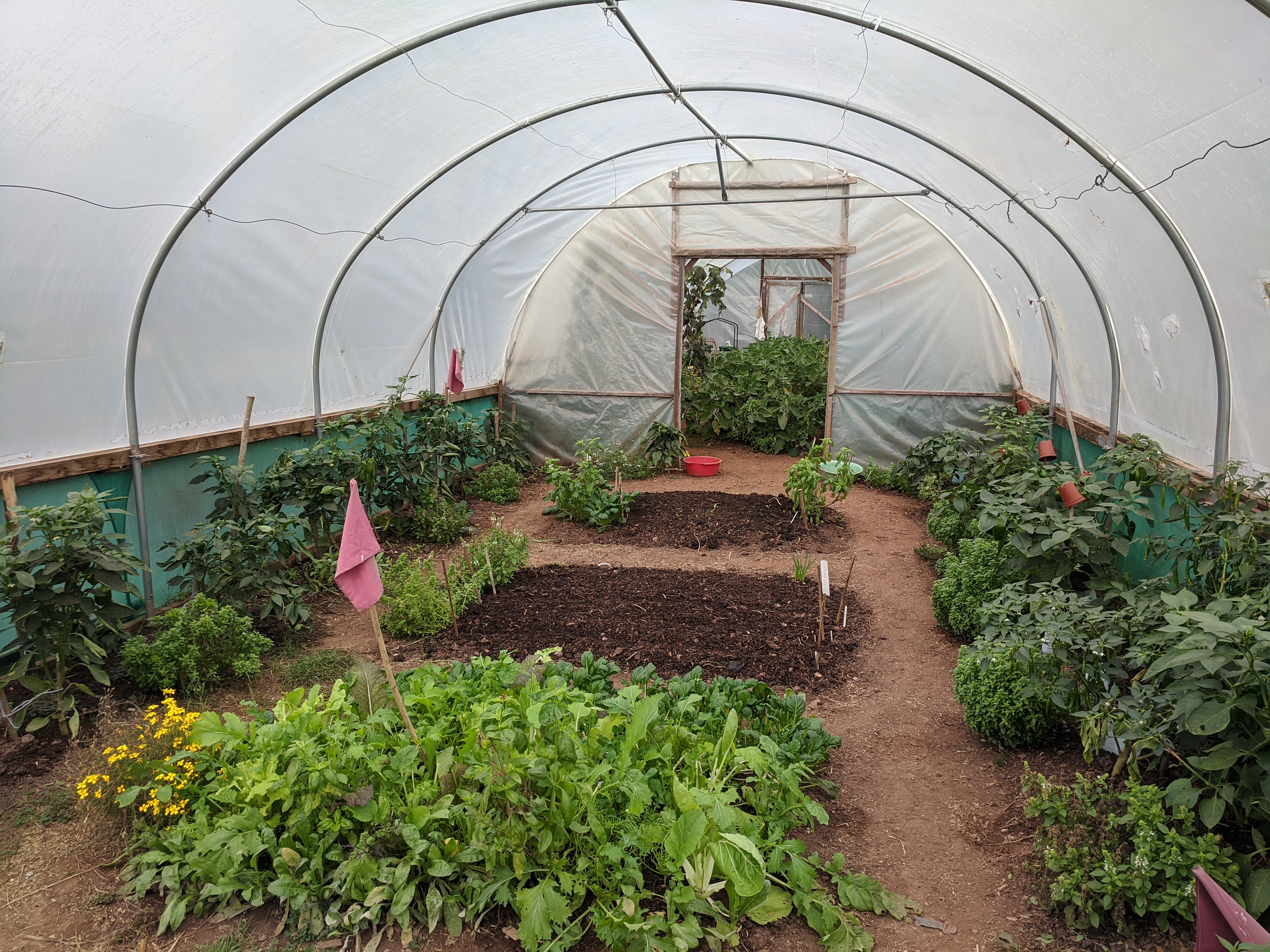
Secondly, I am already part of a growing co-operative and I initially thought ‘I’m already doing this’. Tick, well done me. But I quickly realised it was really only my family (and the families of other members) benefiting from the co-op. Within my community I knew there were people, including one very good friend, relying on food banks. At the same time, I had on several occasions observed surplus food from the plot going on the compost.
So my first foray into activism was taking extra from the plot and giving it to my friend. She was my community, and this food should be going in her belly not on the compost heap. I would do it for my sister, so I would do it for her.
However, my covert efforts weren’t particularly effective. I was nervous and only took stuff that was obviously being wasted, which meant things were a bit past it before I took them. Stringy runner beans and dried out corn cobs anyone? No, didn’t think so. Plus I was only helping out one person, I wasn’t changing the problem of food going to waste.
So I got in touch with the local foodbank to see if they would be able to accept donations. I wasn’t sure as it would be sporadic and when it did come it would be heaps of one variety of veg. However, they were thrilled with the idea. I went back to the co-op and suggested that if there was a glut we give some to the foodbank. I volunteered to organise the donations. They thought it was a great idea too. And so, easy as that, the system was in place.
The growing co-op was set up as part of the Transition movement, i.e. transitioning away from fossil fuels. It means our veg is grown organically in the village instead trucked in from elsewhere. In this sense it is very effective. But we need to go beyond reducing our personal carbon emissions and think about climate justice and community. Sharing surplus with those most in need helps us move in this direction.
And remember, this new action all started with Parable of the Talents, Butler’s dystopian novel.
While researching this post I found out about a growing co-op in the US set up in the name of Earthseed, the community in Butler’s Parables novels. More about them, their aims and practices here.
I started this post by mentioning the Peoples Republic of Stokes Croft. One of the ways PRSC is trying to resist the gentrification of Stokes Croft in Bristol (UK) is by crowdfunding to purchase the property it currently rents.
The aim is to keep it out of the hands of developers and give a secure home to PRSC, in order to benefit the community culturally and financially. If they succeed PRSC will be there forever more, making art and agitating, and they will also pay rent to their community investors. It is, as they say themselves, a “utopian vision”. Anyone can buy a share from £10 (if you live in a local postcode, £100 if not), but no-one can invest more than £35,000. They are looking to raise £272,000 and are about 70% of the way there at the time of writing.
For more information, see https://stokescroftlandtrust.org/.
Stokes Croft is the home of the Bristol Utopian Book Collective, which has always met at Café Kino.

David Bell’s &Utopia lecture ‘Utopia: Another End of the World is Possible’, recorded on 28 October 2021, is now available online. The lecture energises despite (or perhaps because of?) a focus on the apocalypse.
In this lecture Bell poses a great conversation starter, sure to bring out the existentialists in the room, when he suggests there are two types of people, those who believe the world is salvageable and those who don’t. So which kind are you, do you think the world is salvageable?
‘The world’ as Bell refers to it isn’t the physical world but our world, our civilisation. Or, as he defines it more finely, the ‘anti-black empire’ and ‘the science of the plantation writ large’. He keenly points out that utopia is borne of this modern, European ‘world’.
It’s nice to have your murky thoughts about utopia validated and be given the strength to pursue them further.
Bell’s view is that utopia will be transcended by a new social thought, appropriate to the end of this world and formation of another. The structure of this will necessarily be unimaginably different to the modern utopia. It may emerge in the moment rather than being designed, rather like free jazz. It may also be similarly unfathomable and even uncomfortable to the ears. It won’t be made for us.
When prompted on how this relates to utopia as a literary genre Bell suggests this is an open question, which is just as well as I’m planning to keep thinking about it.
With several speakers yet to come and recordings of past lectures available, see the website andutopia.com/.
My hot pick is Françoise Vergès on 16 December 2021.


Studying literature can seem like an indoor sport. As an ecocritic, I can spend days thinking about what it means to be an ecological being while only physically interacting with a desk chair and computer. As a utopian scholar it sometimes feels like I’m trying to work out how society could change to avert climate catastrophe IN MY HEAD. Often, the efforts I make to reach out, like starting a blog for instance, result in more time spent in front of a computer. Recently, I’ve realised that as part of my eco-utopian practice I need to get out of my head.
In July 2021 I responded to a call for volunteers to care for saplings planted on a hill known locally as Toboggan Hill. The land, on Fenswood Farm, Long Ashton, is owned by the University of Bristol.

A field in Fenswood Farm, Long Ashton, Bristol, taken on an evening walk, 18 July 2021. The mound in the background is Toboggan Hill. In February 2020 the hill was planted with 1,600 saplings by University of Bristol along with local group Long Ashton Nature, Community & Environment Trust (LANCET).
It’s simple work clearing grass from the base of the new trees to make sure they aren’t being choked. While participating I’ve found out more about the land around where I live. What I’ve learnt is kind of shocking. I’ve glimpsed how this patch of land is connected to the whole web of human activity affecting (and effecting) the climate crisis. But on the positive side, I’m seeing the work that can and is being done locally to tug on those threads of connection, loosen them and rework the land into a healthier place.
Long Ashton has the claim to fame of being the place where Ribena was invented. It was developed at the Long Ashton Research Station in the 1930s. I was beyond thrilled to learn this after moving to the village. If my childhood self knew I would grow up to live in the birthplace of Ribena…
For the benefit of those who didn’t have a UK childhood, Ribena is a very sweet blackcurrant cordial. It is high in Vitamin C, which was handy during World War II when we couldn’t get oranges. For decades afterwards it was marketed as healthy and dutifully my Dad and Gran would give it to us when we were poorly. I still turn to a hot Ribena when I get a cold today and have an emergency bottle in the cupboard in case I get COVID-19. There is a low sugar version, which I bought once by mistake and I don’t want to talk about it.
Long Ashton Research Station closed in 2003 and much of the land around it was sold for housing development. The University of Bristol retains Fenswood Farm, land that I understand was gifted to it for research purposes.
While the agricultural land is available as a resource for academics and students, it seems under-utilised as such. In practice the land is used to grow arable crops, which are exported for animal feed. This, and its ‘further development potential’ as noted on the university website, leads me to think it is primarily being treated as a financial asset.
Long Ashton saw a massive increase in desirability in 2021, as the pandemic led people to seek homes outside of the city. While right on the edge of Bristol, it has a lot more space and access to countryside. According to The Sunday Times, it was one of eight postcodes in the UK where average house prices rose by more than £100,000 in a year.
But what is this ‘countryside’ that surrounds the village? By moving here are you any closer to nature? When the fields are dusted with slug pellets and the produce goes to feed industrially farmed animals overseas?
The other side of the village is bordered by a golf course, which is also intensively managed with no doubt widespread use of herbicides and pesticides. What we are surrounded by isn’t ‘nature’ but global commodities on the one side and leisure industries on the other.
I haven’t yet mentioned the climate crisis, but I trust readers can see the current usage of the land around Long Ashton is perpetuating behaviours that have led to the climate and ecological emergencies. We often think of green spaces as a tonic to industrialisation, pollution and our worries about the environment, but any comfort taken here might be misplaced.

LANCET is working to increase biodiversity in Long Ashton. This includes the usual advice to residents to sow bee and butterfly-friendly wildflowers, make a hole in your fence for the hedgehogs and install a bug hotel. But what makes me really excited about their work is they are engaging with the university about the 62 hectares it owns in Long Ashton. The saplings are growing, and the next project is to lease another field to plant a wildflower meadow.
Ultimately, it would be fantastic for the fields around Long Ashton to be supporting a range of wildlife and potentially growing food to be consumed locally – or at least by humans.
I’m glad I made it away from my computer, out of my flat and into a field full of saplings. I feel a little connection to every tree I help, I’m connecting with a group of local people, and noticing the connections between my village and global ecologies and economies. I’m doing physical work, spending time in my body and in my surroundings. The work feels meaningful, necessary and relevant, and makes me feel the same about my academic work. I’m enjoying the way they feed into each other.

Misunderstanding
Saved by the sapling
Sapling was growing
Misunderstanding, This Is The Kit

How about judging utopias by how they party? Utopia scholar and Bristol Utopian Book Collective member Dr Kirsten Harris made this suggestion in our discussion of N. K. Jemisin’s ‘The Ones Who Stay And Fight’, written in response to Ursula K. Le Guin’s ‘The Ones Who Walk Away From Omelas’. I think it’s an excellent idea. As a way into a utopia it’s potentially much more insightful and fun than talking educational systems and politics.
Thinking about how an ‘ideal’ society parties helped me pinpoint my misgivings with the Transition movement.* Don’t get me wrong, the Transition Initiative is right up my street. I’m a member of the Long Ashton Growers, set up by Transition Long Ashton, and I have a copy of The Transition Handbook by Rob Hopkins on my lap as I write. But I can’t see the Transition movement having the impact it wants because it doesn’t party how people really want to party.
*The Transition movement is a network of communities in towns, villages and cities in the UK attempting to be the change they want to see in the world and lead the transition away from oil-dependency. This often involves producing food locally, for instance.
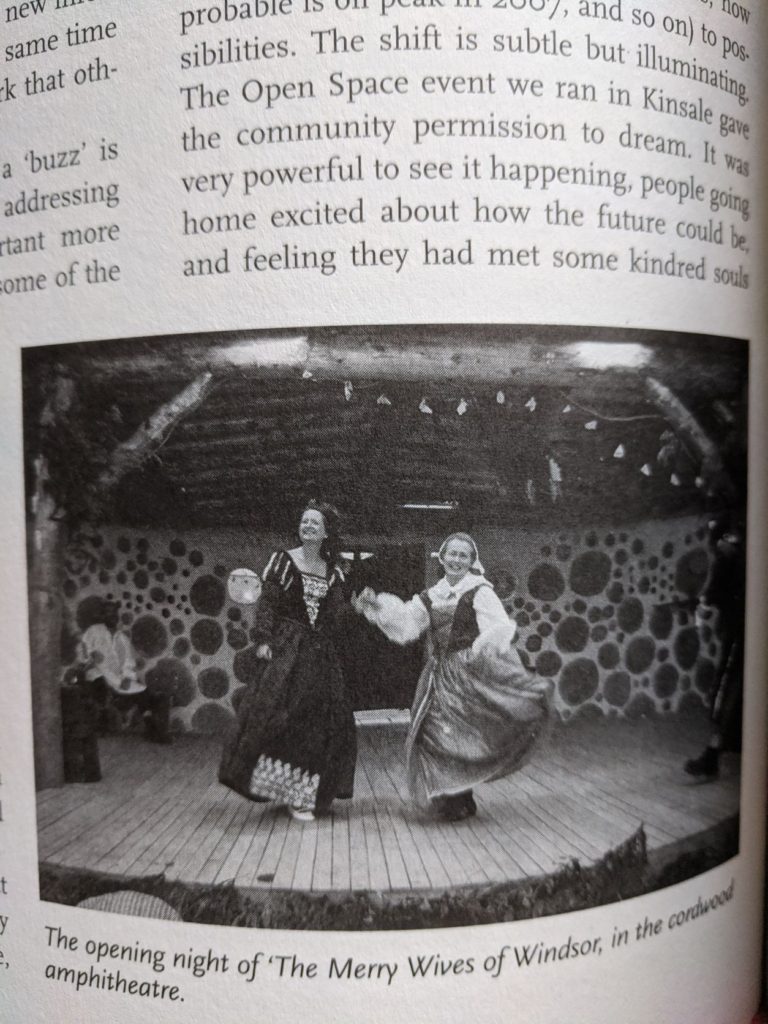
Not everyone wants to party like it’s 1599 (or thereabouts). There has to be more to eco-utopian parties than acoustic folk music and open air theatre. This is where I want to bring in Dr Nicole Seymour, and her work-in-progress on a cultural history of glitter.
Back in May 2021 I attended an online talk by Seymour, hosted by UCD Environmental Humanities, entitled ‘Facing the Plasticene: Object Lessons from Glitter’. Glitter provokes a lot of ecological ire, being as it generally consists of tiny bits of plastic. But, as Seymour explained, glitter makes up a tiny proportion of the microplastics that make their way into soils and oceans. By far the biggest source of microplastic pollution is fibres from clothing. So why the disproportionate fuss about glitter?

Seymour pointed out that while some environmentalists might consider glitter a needless frivolity, it is culturally important to LGBTQ+ communities and (typically Black) cultures with a carnival tradition. Imagining celebrations without glitter therefore, consciously or unconsciously, excludes certain groups from the utopian party.

One solution is eco-glitter. Seymour briefly surveyed this industry and how it agonises over how much plastic is in the product and the ethical sourcing of natural alternatives. Sparkly mineral mica, for instance, is sold as an ecological alternative to plastic glitter, but naturally occuring mica is often mined using child labour. Ethically-conscious companies have turned to lab-made mica instead so I guess you have to check before you buy.
The advantage of eco-glitter is it facilitates being both sparkly and environmentalist. The two need not be mutually exclusive. This is great news for the eco-utopian parties and their guest lists. But I have some lingering doubts about the necessity of this product. Specifically about the need to buy premium cosmetics. Does eco-glitter exist because glitter is a big ecological problem, or because eco-glitter is a lucrative product to sell?
In the Q&A following Seymour’s talk, one of the other attendees expressed their discomfort with the capitalist nature of the eco-glitter market. They asked if there might be such a thing as a glitter commons. Now this captured my attention. Given that, as Seymour noted, the practice of decorating oneself for special occasions and purposes is universal across human cultures, why are we buying in the glitter?
Before a party, someone preps the food, gets in the drinks, puts together the playlist, sorts out the lighting. The guests try on their outfits, decide what to wear, work out how to get to the venue. Often these things are done in collaboration and that’s part of the fun. Add in team glitter creating the sparkles and we might be on the way to a utopian party.

Although I can’t entirely articulate it yet, I have started to think the decolonial thought. Put crudely, the decolonial thought is along the lines of:
Our prevailing understanding of our culture and history has been shaped at every level by white settlor men and it is beyond time to start listening to somebody (everybody) else.”

According to the internet, the human population of planet Earth is around 30% white and 48% male. I’m quite good at maths, so I can tell you this means white men make up around 14% of the global human population. My conclusion from this is that the white male is not the default human!
Add in other qualifiers like straight, cisgender and able-bodied and ‘Man’ of ‘mankind’ can be seen to be a tinier and tinier proportion of our global population.
The way we have been led to perceive our past, present and future serves a tiny proportion of humanity. It is not healthy, for us or the planet.

The decolonial thought is a valve or a sphincter, like Timothy Morton‘s ecological thought. Once you’re through, there is no going back.
Of course there are ecological thoughts. […] But there is a particular kind of thinking that I call the ecological thought. It runs like a strand of DNA code through thousands of other kinds of thoughts. […] It is not simply a matter of what you’re thinking about. It’s also a matter of how you think. Once you start to think the ecological thought, you can’t unthink it: it’s a sphincter – once it’s open, there’s no closing.”
Timothy Morton, The Ecological Thought
The decolonial thought and the ecological thought are also connected through the cause of climate justice. Although I have much more thinking to do around these big thoughts, what I take from this in brief is:
SMASH ALL THE HIERARCHIES!

Recently, I stumbled across a cartoon about Thomas More’s Utopia on Existential Comics. More is telling a crowd all the good stuff about Utopia. He’s winning them over with a six hour working day and leaders chosen by the people to rule in their best interests. But he starts losing them when he reveals there’s no boozing and no fancy clothes. To spice things up a bit, he comes out with:
“Wait, what? There still slaves in Utopia?” It’s funny cos it’s true. Here we are, excited about this anti-capitalist, essentially communist, society, but there are still slaves in Utopia. As readers of Utopia, as in More’s book, and of utopia, the literary genre it spawned, we need to ask what’s with the slaves in Utopia?
The most boring cop out answer is it’s of it’s time. It was published in 1516, slaves were alright then, you can’t judge it by modern standards, we don’t have to worry about the fact it has slaves in it.
I say wrong, wrong, wrong. We do precisely have to worry about it because slavery was never an OK idea. We need to critically evaluate our (Anglo-Euro-American) history and how it feeds into a culture of forgiving the past because ultimately we did pretty well out of it. Also, if we are tempted to be proud of a literary heritage of utopia stretching back to 1516 and make claims for the enduring relevance of this genre today, we need to look carefully at what these ideas are that are still circulating.
What’s funny about the slaves in Utopia, why it’s extra odd, is that Utopia is a radically anti-capitalist place. There’s enough of everything for everyone and citizens are socially conditioned to look down on material wealth. Gold and silver are used to make chamber pots and chains for slaves, and pearls and gems are used for children’s toys. There’s effectively no private property and yet… there are slaves. How does this add up?
I have a theory and it goes a bit like this. Colonialism.
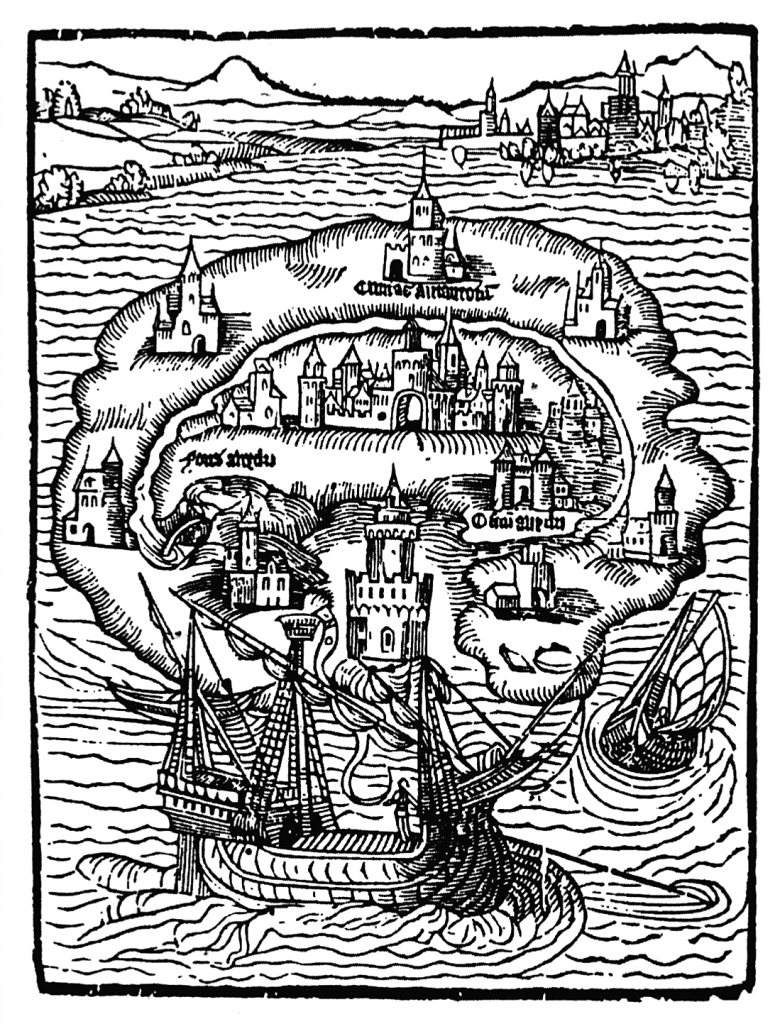
In More’s Utopia, the land called Utopia wasn’t always called Utopia. It was originally called Abraxa, until King Utopus conquered and renamed the place. Good King Utopus did such a good job of civilising the natives he made the ideal society.
Not only this, but Utopus reshaped the entire physical environment to create his model of perfection. Utopia was originally on a peninsula, but Utopus ordered a huge channel to be dug to cut it off from the mainland, turning it into an island.
The sheer entitlement of these heroic acts of Utopus. They epitomise colonial logic, by which I mean the logic of dominating other people and other places in pursuit of the perfect civilisation.
With this as its foundational myth, Utopia might be anti-capitalist, but it’s still colonialist.
Colonialism assumes the world is divided into masters and subjects. I am reminded of Val Plumwood’s Feminism and the Mastery of Nature. Plumwood identifies a series of dualisms at the heart of Western thought – man/woman, culture/nature, mind/body – where the first in each of pairing is assumed superior to the second. Master/slave.
Certainly, More’s hero asserts control over nature when he turns the land into an island. King Utopus fits the category of “man”, “culture”, “mind”, “master”. And where there’s a master, there’s got to be slaves. So by this colonial logic, the logic of mastery, it makes sense that there are slaves in Utopia.
Having concluded that the slaves in Utopia demonstrate the colonial logic at the very foundation of the genre of utopia, what do we do now? Despair?
No! Don’t despair, decolonise!
By which I mean, be alive to the colonialist tendencies within utopia. Call it out when you see it. And, even better, read loads of innovative anti-colonial utopias and think about alternative ways of reimagining the world. That’s what I’m doing anyway. Keep reading this blog to come along for the ride!


As I mentioned in my last post (the one before Rob Bryher’s article on car free cities and environmental justice), I haven’t been reading novels lately. Since admitting this, I’ve felt more able to focus on what I am currently enjoying in the world of utopia, and consciously taking pleasure from those things. This includes essays, online talks and events, and adding to my reading list for that future day when the book lust kicks in again. It’s a lesson in being led by what I enjoy. So here’s my round up of the utopian things bringing me joy this month.
Loyal followers of the blog will know I have an awesome utopian reading list focusing on Afrofuturist, African Sci-Fi and Black Utopias. I featured it back in my inaugural blog post.
This week I’ve added the following:
Bacon shared her essay ‘Black Lives Matter – The Rise Of Future Forms, Genres and Modes’ on twitter this week. The essay is something of a wormhole, leading to more of her own essays and a whole host of recommendations of work from other Black writers. Particularly high on my list are the New Suns and New Suns 2: Original Speculative Fiction by People of Color anthologies edited by Nisi Shawl (more from Shawl below).
I read Octavia Butler’s Parable of the Sower in July 2019 during an extreme heatwave in Europe. I was in Prato, Italy for a conference on utopia and climate change and it was 39℃ (103℉). We were melting while we talked about climate catastrophe and apocalypse, the air conditioning failing around us. Trump was in power in America. It was all too real.
I really want to read Parable of the Talents but now we’re living through another dystopia (yes, the pandemic) I’m worried about finding it a bit much. This is where I see Octavia’s Parables stepping in.
This podcast (which I missed off my utopia and climate justice podcasts list), hosted by Toshi Reagon and adrienne maree brown, takes Parable of the Sower (season one) and Parable of the Talents (season two) one chapter at a time. I feel that in this supported way, chapter by chapter, I could read Parable of the Talents, at what is undoubtedly a pertinent time to do so. Based on brown’s key note discussion of Butler at the New Suns online literary festival, I know she has both a deep love of Octavia Butler and doula skills for guiding people through potentially traumatic experiences. So I’m going to trust in the podcast, is what I’m saying.

Here’s a zero effort way to indulge in all things sci-fi and utopia. I treated myself by making time to catch up on this recorded event from February 2021, featuring Meg Elison, Nalo Hopkinson and Nisi Shawl, with Terry Bisson as moderator.
Highlights for me were:
Back home in Bristol, the People’s Republic of Stokes Croft have been running a three week School of Activism. One class, hosted by Invented Futures, was on ‘Speculation, Visionaries and Modern Mythologies‘. Invented Futures is a collective based at Spike Island in Bristol looking at new technology and the stories that drive the tech we invent. (That’s my interpretation of what they do anyway, I’d like to talk to them and find out more!) One of the speakers was Katie Stone of Utopian Acts, a collective I’ve collaborated with before. So I felt at home on several accounts and relished the discussion.
One text that Katie brought up was Nalo Hopkinson’s Midnight Robber. She spoke of how the book contrasts the technological knowledge of two different worlds, one hi-tech and the other seemingly primitive. Since watching the Stranger Than Fiction roundtable I was thinking I wanted to read something by Hopkinson. As usual though, I couldn’t pick which book to start with. But here was Katie talking about Midnight Robber… Is this a sign, I thought?
And do you know what, I think it was a sign. I think I’ve chosen my next book to read. I might be about to get back into reading, spending delicious quiet hours with a book, tea and quite possibly also chocolate. I’ll let you know how it goes.