


The thing that took me farthest out of my comfort zone in 2022 was attending the Utopian Studies Society conference. I thought it would be nice to have a few days away to discuss all things utopian but I was wrong. I stretched my elastic too far just to get there. It was my first time travelling on my own and travelling much at all since the pandemic and having a child (both things that have tied me to home over the past few years). Having to then leave my room and attend events was so hard. This is despite my room (in student halls) being unbearably hot and depressing.
Yes, this was another USS conference in a heatwave, like the previous one in Prato, Italy in 2019 where we discussed utopia, dystopia and climate change in 40 degree heat (Celcius, folks). Just the thing to make discussions feel urgent and hopeless at the same time.
Utopia and the Plantationocene
My talk was deliberately provocative, which is something I like to do. We’re all in a room together so let’s provoke a bit of conversation. I stood up and argued that the logic of utopia is the same as the logic of the plantation. I said:
- The foundation story for Utopia (the place) in Thomas More’s Utopia (the genre-founding book of 1516) is settler-colonist fantasy. King Utopus conquered the land of Abraxa, named it after himself, and ‘brought the rude and uncivilized inhabitants into such good government, and to that measure of politeness, that they now far excel all the rest of mankind’
- More was not only inspired by the colonisation of North America by his fellow Europeans but contributed to the ongoing settlement of the continent. In Karl Hardy’s words, ‘Utopia clearly articulates the settler colonial doctrines of terra nullius [no man’s land], vacuum domicilium [unoccupied home], and inane ac vacuum [idle and waste] which were used by European powers to establish legalistic grounds […] for expropriating the supposedly unhabited land’
- Donna Haraway and Anna Tsing describe how the Plantationocene – the era of the plantation and its transformative effects upon our planet – started at the same point in history. Plantations were a new form of agriculture designed by Europeans specifically for slave labour in the New World
- More’s Utopia reflects and expresses plantation logic, just as surely as it is inseparable from the colonisation of America. Utopia (the place, the book and the genre) is about establishing systems of control to obtain a perfect outcome. Further, it imagines the means of enforcing the ways of being required to perpetuate said perfect state. The logic of utopia is the logic of the plantation
And the response? No-one challenged me. No-one even batted an eyelid. They nodded, apparently agreed, and carried on with the utopian studies conference.
Decolonising Utopian Studies
The colonialism at the heart of utopia is an open secret in utopian studies. Some scholars do, however, address it directly. On a panel titled ‘The Past and Future of Utopian Studies’, Caroline Edwards spoke on ‘Decolonising Utopian Studies’. It was undoubtedly one of the most important contributions to the conference.
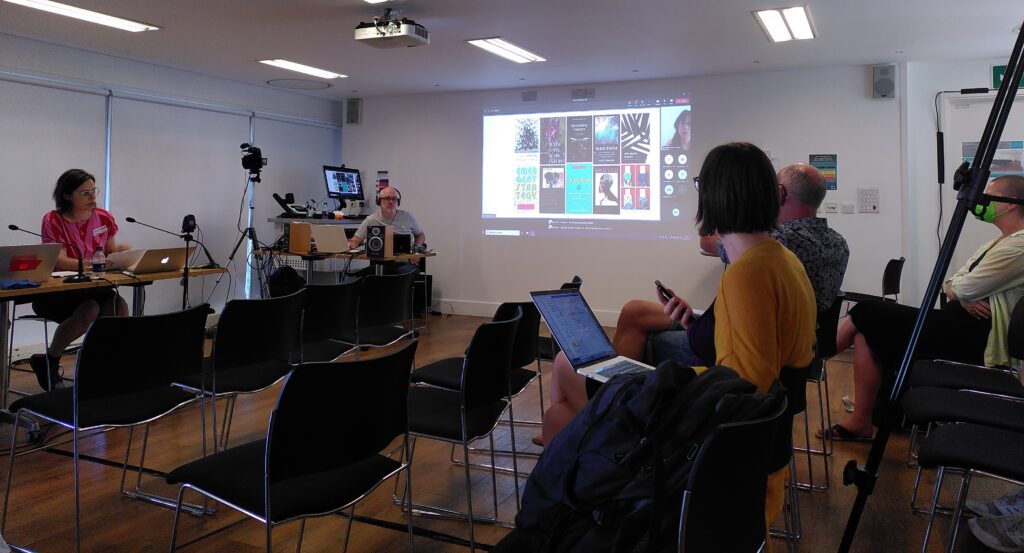
She started out with a list of sources, including:
- In the Wake: On Blackness and Being by Christina Sharpe
- Queer Times, Black Futures by Kara Keeling
- Becoming Human by Zakiyah Iman Jackson
- Black Utopia by Alex Zamalin
- Hope Draped in Black by Joseph R. Winters
- Emergent Strategy by adrienee maree brown
- Posthuman Blackness and the Black Female Imagination by Kristen Lillvis
- Undrowned by Alexis Pauline Gumbs
- Habeas Viscus by Alexander G. Weheliye
She asked why these texts and authors are not being talked about in utopian studies. And why black speculative imaginaries are not coming to utopian studies. Why are we not citing them and why should they bother citing us?
Funding Utopia
I suspect this might come down to studying an essentially colonialist genre within a colonialist institution – the university. Why would anyone exploring anti-colonial ways of being want to come towards that? Later on the same panel, Adam Stock highlighted a key obstacle for going the other way: funding. Anyone working within utopian studies on this area is trying to get funding from the very institutions that the research will criticise.
As someone on the periphery of academia, the poolside if you will, this conference made me think twice about jumping back in. Especially when Caroline Edwards talked about how adrienne maree brown (idol) could not do what she does if she was working within academia. She could not do her critical writing and thinking alongside being a doula and a poet plus do teaching and research in the form that academia demands. It made me think about what the real, important work is and where it happens. And those thoughts are ongoing.


